
This guide covers installation, setup, operation, and maintenance for the BioTek 405 TS Microplate Washer used in ELISA and immunoassays.
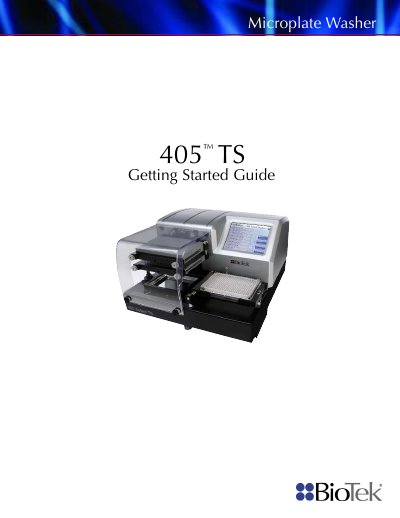
The BioTek 405 TS Microplate Washer is designed for microplate priming, washing, and dispensing in ELISA, fluorescence, and chemiluminescence immunoassays, as well as cellular and agglutination assays. This Getting Started Guide provides essential instructions for quickly setting up the instrument, including unpacking, installing software, and defining initial settings. It also outlines basic operation procedures for creating and running protocols on the touchscreen interface.
| Labware Compatibility | 96-well, 384-well that comply with SBS microplate standards 1-2004, 2-2004, 3-2004, and 4-2004 |
|---|---|
| User Interface | 5.7" touchscreen |
| Power Supply | 24-volt 60 watt and 48-volt 60 watt |
| Dimensions | 14x17x10 inches (36cmx43cmx25cm) |
| Weight | 32 lb (14.5 kg) |
| Operating Temperature | 10°-40°C (50°-104°F) |
| Relative Humidity | Maximum 80% at temperatures up to 31°C |
| Manifold Type | 96-tube Single or Dual manifold |
It provides microplate priming, washing, and dispensing for ELISA, fluorescence, and chemiluminescence immunoassays, cellular and agglutination assays.
Yes, if the instrument has an 'IVD' label; otherwise, it is for research and development and non-clinical purposes only.
Safe chemicals include buffersolutions (such as PBS), saline, surfactants, deionized water, 70% ethyl, isopropyl, or methyl alcohol, 40% formaldehyde, and 20% sodium hydroxide.
Never use acetic acid, DMSO, or other organic solvents as they may cause severe damage to the instrument.