
This application note describes PC-based evaluation techniques for Direct Digital Synthesis (DDS) devices, including software control and bench setup…
The document discusses the use of Personal Computers as a programming vehicle for evaluating Direct Digital Synthesis (DDS) products. It highlights that software written in Visual Basic or C++ allows designers to operate DDS devices via a menu-driven interface on Windows. The text notes that while PC-based control is effective, sophisticated high-speed operations like frequency hopping may require additional user-provided hardware such as FPGAs or microcontrollers.
Software written in Visual Basic or C++ allows designers to fully operate the DDS via a menu-driven control panel.
Frequency hopping, spread-spectrum, and modulation require additional user-provided hardware such as an FPGA, micro-controller, or other components.
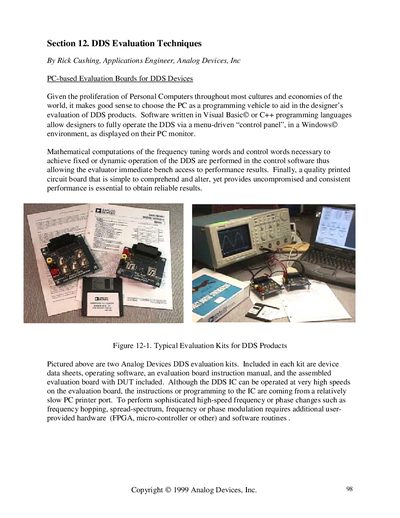
Each kit includes device data sheets, operating software, an evaluation board instruction manual, and the assembled evaluation board with DUT.