
Instruction manual for the Alpha Diagnostic Intl Human IgG ELISA Kit, Cat. No. 1750, a quantitative in vitro immunoassay for research use only.
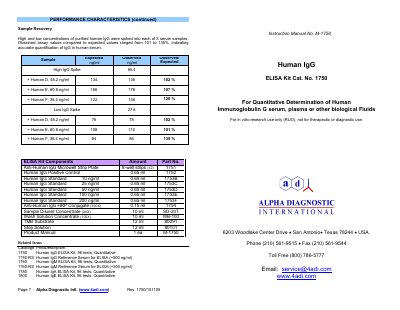
This is the instruction manual (No. M-1750) for the Alpha Diagnostic Intl Human IgG ELISA Kit, Cat. No. 1750, supplied as 96 tests. The kit is an in vitro immunoassay for the quantitative determination of human immunoglobulin G in serum, plasma or other appropriately qualified samples such as tissue fluids and cell cultures. It is intended for in vitro research use only and is not for therapeutic or diagnostic use.
The manual describes the intended use and principle of the test, storage and stability, kit contents and reagent preparation, calculation of typical results, and performance characteristics including specificity, normal range, precision, linearity of dilution and sample recovery. The assay uses an anti-human IgG coated microwell strip plate, HRP-conjugated anti-human IgG, five human IgG standards from 10 to 200 ng/ml, a positive control, TMB substrate and stop solution, with absorbance read at 450 nm.
| Kit catalog number | 1750 |
|---|---|
| Number of tests | 96 tests |
| Standard concentrations | 10, 25, 50, 100 and 200 ng/ml |
| Microwell strip plate format | 8-well strips (12) |
| Storage temperature | 2-8 °C until expiration date |
| Measurement wavelength | 450 nm |
| Sample types | Serum, plasma or other appropriately qualified samples |
| Intra-assay precision | 3.9 to 6.8 %CV |
| Inter-assay precision | 6.4 to 13.2 %CV |
| Normal IgG range in stored sera | 3.5 to 15 mg/ml (median 10 mg/ml) |
It is an in vitro immunoassay for the quantification of IgG circulating in serum, plasma or other appropriately qualified samples. It is for research use only, not for therapeutic or diagnostic use.
The microtiter well plate and all other reagents, if unopened, are stable at 2-8 °C until the expiration date printed on the label.
After the stopping solution is added, absorbance is measured at 450 nm using an ELISA microtiter well reader.
Samples producing signals higher than the 200 ng/ml standard should be further diluted and re-assayed.
Concentrations are determined by interpolation from the standard curve, and the values obtained are multiplied by the dilution factor of each sample.