
The Ai-Thinker ESP8266 WiFi Module User Manual provides an overview, hardware details, AT command reference, and specifications for the module.
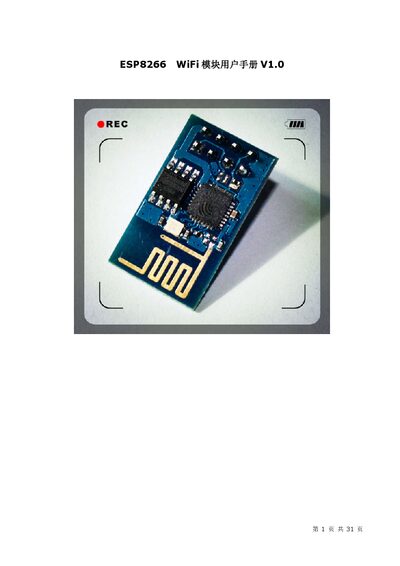
This manual introduces the ESP8266, a low‑power UART‑WiFi transceiver designed for IoT applications. It describes the module’s features, packaging options, and typical use cases such as smart grids, transportation, and industrial control.
The document covers hardware interfaces, power consumption, RF performance, pin definitions, and a full set of AT commands for Wi‑Fi, TCP/UDP, and configuration. It also includes a test board overview and information on firmware upgrades and OTA updates. This manual is written in Chinese.
| Wireless standard | IEEE 802.11b/g/n |
|---|---|
| Frequency range | 2.412 GHz – 2.484 GHz |
| Transmit power (802.11b) | +16 ± 2 dBm |
| Receive sensitivity (802.11b) | -93 dBm |
| Working voltage | 3.3 V |
| Standby current | <200 µA |
| Operating temperature | -40 °C ~ 125 °C |
| Dimensions (PCB antenna version) | 14.3 mm × 24.8 mm × 1 mm |
Use the AT+CWMODE command to select STA, AP, or STA+AP mode.
The module draws less than 200 µA in standby.
It supports a PCB antenna, an I‑PEX connector, an SMA connector, and an external stamp‑hole antenna.