
The Behringer C-3 is a large-diaphragm studio condenser microphone that provides heart, omni, and figure-8 polar patterns, as well as low cut and -10dB pad features.
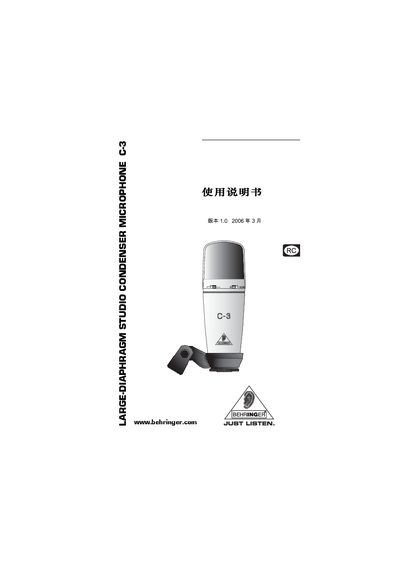
This manual provides safety guidelines and power requirements for the Behringer C-3 large‑diaphragm condenser microphone, including the need for +48 V phantom power and handling precautions. It describes the three selectable polar patterns (cardioid, figure‑8, omni) and how to enable low‑frequency and signal‑level attenuation using the front‑panel switches.
Installation instructions cover the supplied rotating foot‑mount adapter, mounting on standard mic stands, and recommended balanced XLR cables with gold‑plated pins. The technical specifications section lists sensitivity, frequency response, maximum SPL, impedance, dimensions and other key performance data.
| Type | Condenser transducer |
|---|---|
| Diaphragm Size | 16 mm |
| Polar Patterns | Cardioid, Figure‑8, Omni |
| Connection | Gold‑plated balanced XLR (3‑pin) |
| Sensitivity | -40 dBV/Pa (10 mV/Pa) |
| Frequency Range | 40 Hz – 18 kHz |
| Maximum SPL | 142 dB ( <0.5 % THD @ 1 kHz) |
| Equivalent Noise Level | 23 dBA (IEC 651) |
| Dynamic Range | 119 dB |
| Impedance | 350 Ω |
| Supply Voltage | +48 V phantom power |
| Current Consumption | 7.0 mA |
| Dimensions (Diameter × Length) | 54 mm × 180 mm |
| Weight | ≈0.45 kg |
The C-3 requires +48 V phantom power supplied by a microphone pre‑amp or mixer.
Use the switch on the back of the microphone to choose cardioid (center), figure‑8 (left) or omni (right).
Flip the switch on the left side of the front panel to activate the low‑frequency cut filter.
Use a balanced XLR cable with gold‑plated pins for optimal connection.