
This document presents a new tourism product that combines the concepts of community tourism and sustainable development. The product is designed to protect the environment and benefit local communities.
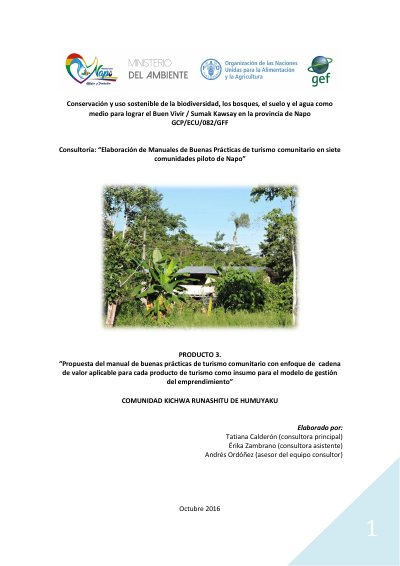
This Spanish-language document is Product 3 of a consultancy to develop community tourism best-practices manuals for seven pilot communities in the province of Napo, Ecuador, carried out in October 2016 under the GEF Napo project "Conservación y uso sostenible de la biodiversidad, los bosques, el suelo y el agua" (GCP/ECU/082/GFF). It covers the Kichwa community Runashitu de Humuyaku and was prepared by consultants Tatiana Calderón, Érika Zambrano and Andrés Ordóñez.
The manual applies a "traffic light" (semáforo) monitoring methodology, rating each link of the tourism value chain — research, product design, promotion and marketing, pre-operation, operation, and after-sales and continuous improvement — in red, yellow or green according to the community's compliance with good practices. For Runashitu, a community of 47 families and 293 inhabitants that has not yet begun tourism activity, the diagnosis is rated red, and the document identifies two attractions (the Unuyaku River and the Runashitu forest under the Socio Bosque program), describes access from Tena, basic services, environmental problems, and the community's needs and investment plan. This manual is written in Spanish.
| Community population | 47 families, 293 inhabitants |
|---|---|
| Travel time from Tena by car | Approximately 2 to 2.5 hours |
| Public transport fare from Tena | $4.5, once a day |
| Electricity coverage | Covers the whole community |
| Identified tourist attractions | Río Unuyaku and Bosque de Runashitu |
The "traffic light" (semáforo) methodology, which rates each value-chain link red, yellow or green, with green meaning full compliance with good practices.
No. The community has not yet begun tourism activity and does not consider tourism a productive activity, so its value-chain diagnosis is rated red.
Via the Tena–Chontapunta road; about 5 km past the Chontapunta Millennium School is the community entrance, with a trip of roughly 2 to 2.5 hours by private car.
Oil activity at the head of the Unuyacu River, which risks water quality, and waste problems, since garbage collection comes only every fifteen days and residents burn or bury the rest.