
This instruction manual covers the operation, setup, alarms, maintenance, and safety precautions for the Breas Medical NIPPY 3+ positive pressure ventilator.
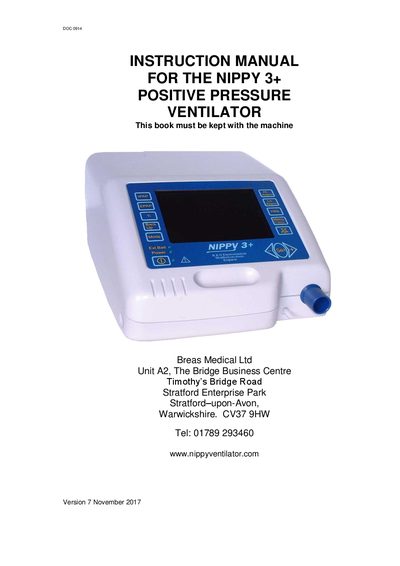
The NIPPY 3+ is a pressure-controlled, positive pressure ventilator designed for non-dependent, spontaneously breathing adult patients with respiratory insufficiency or failure. It delivers compressed ambient air to the patient via a full-face mask, nasal mask, nasal pillows, or tracheostomy. The device features a color LCD screen for displaying settings and alarms, which can be adjusted using fascia buttons and an on-screen menu. It supports four ventilation modes: CPAP, Pressure Support, Pressure Control, and IPPV.
| Ventilation Modes | CPAP, Pressure Support, Pressure Control, IPPV |
|---|---|
| Intended Patient Type | non-dependent, spontaneously breathing adult patients |
| Trigger Sensitivity Scale | 1 – 10 |
| Low Pressure Alarm Threshold | below 50% of the set IPAP level for 10 seconds |
| High Pressure Alarm Threshold | above 120% of the working pressure |
The device must be prescribed by, and used only under the supervision of a qualified physician.
No, this device is not intended for use as a critical care ventilator, transport ventilator or for dependent patients.
The device supports invasive use with a Tracheostomy, Full Face Mask, Nasal Mask, or Nasal Pillows.