
Cal Sensors PbS & PbSe Infrared Detector Selection Guide

This document describes the features and advantages of Cal Sensors' lead sulfide (PbS) and lead selenide (PbSe) infrared detectors.
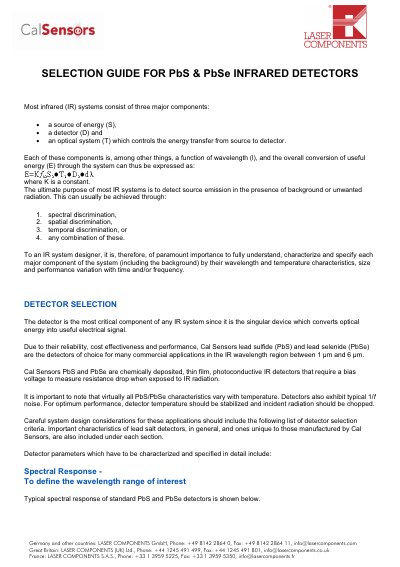

Cal Sensors PbS & PbSe Infrared Detector Selection Guide - cover page
Brand
Cal Sensors
Category
Other Electronics
Document type
Product Leaflet
Language
English
Pages
13
File format
PDF
File size
1.1 MB
Published
17 November, 2023
Updated
17 November, 2023
MD5 checksum
787D497ABDB6681FA6C5EE1FECCA1C06

About this manual

This document serves as a selection guide for Cal Sensors lead sulfide (PbS) and lead selenide (PbSe) infrared detectors. These chemically deposited, thin film, photoconductive detectors are designed for commercial applications in the IR wavelength region between 1 µm and 6 µm. They require a bias voltage to measure resistance drop when exposed to IR radiation.

What's inside

  • Detector Selection
  • Spectral Response
  • Detectivity
  • Responsivity
  • Detector Operating Temperature
  • Detector Response Speed
  • Detector Dark Resistance
  • Detector Bias
  • Multi-Color Detectors
  • Arrays

Frequently asked questions

What are Cal Sensors PbS and PbSe infrared detectors made of and how do they operate?

They are chemically deposited, thin film, photoconductive IR detectors that require a bias voltage to measure resistance drop when exposed to IR radiation.

What wavelength region are these detectors used for?

They are used for many commercial applications in the IR wavelength region between 1 um and 6 pm.

What conditions are recommended for optimum performance?

Detector temperature should be stabilized and incident radiation should be chopped.

What cooling method is described as most cost effective and reliable?

Solid state thermoelectric (TE) coolers are the most cost effective and reliable among cooling devices.

Download PDF (1.1 MB)