
Key facts
- Manuals
- 1
- Languages
- EN
- Last added
- 2023-11-17
Featured Cal Sensors manuals
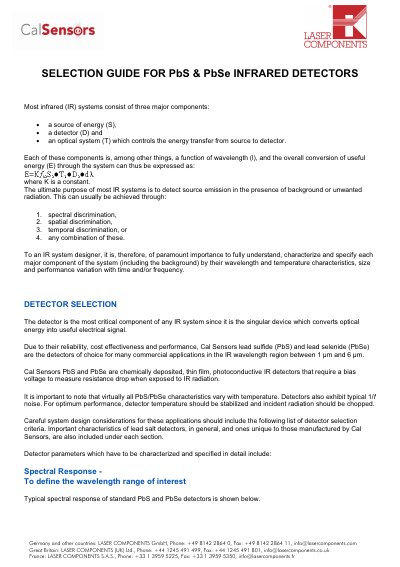
Cal Sensors PbS & PbSe Infrared Detector Selection Guide
This document serves as a selection guide for Cal Sensors lead sulfide (PbS) and lead selenide (PbSe) infrared detectors. These chemically deposited, thin film, photoconductive detectors are designed for commercial applications in the IR wavelength region between 1 µm and 6 µm. They require a bias voltage to measure resistance drop when exposed to IR radiation.
Covers: Detector Selection · Spectral Response · Detectivity · Responsivity · Detector Operating Temperature · Detector Response Speed
Latest Cal Sensors manuals
Cal Sensors PbS & PbSe Infrared Detector Selection Guide
Product Leaflet 13 pages · 1.1 MB · ENA selection guide for Cal Sensors PbS and PbSe infrared detectors, detailing spectral response, detectivity, and operating parameters.
Questions answered in Cal Sensors manuals
What are Cal Sensors PbS and PbSe infrared detectors made of and how do they operate?
They are chemically deposited, thin film, photoconductive IR detectors that require a bias voltage to measure resistance drop when exposed to IR radiation.
From: Cal Sensors PbS & PbSe Infrared Detector Selection Guide
What wavelength region are these detectors used for?
They are used for many commercial applications in the IR wavelength region between 1 um and 6 pm.
From: Cal Sensors PbS & PbSe Infrared Detector Selection Guide