
This document presents a data users guide to the World-Wide Standardized Seismograph Network (WWSSN).
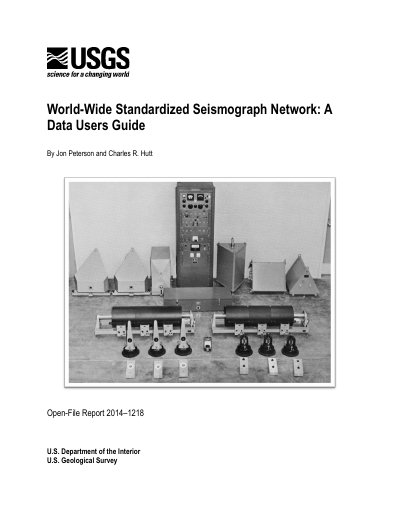
This U.S. Geological Survey open-file report is a data users guide for the World-Wide Standardized Seismograph Network (WWSSN). It was originally drafted in the late 1970s and published in 2014. The foreword describes the network as the first community instrument that enabled global seismology to become a quantitative, predictive science, with data from approximately 100 stations around the world.
The report covers network configuration and station information, instrumentation, station facilities, operating procedures, seismogram format and noise characteristics, system transfer functions, and calibration. It also includes appendices on deriving a generalized WWSSN transfer function and profiling a long-period step response. Installation history in the preface notes the first system was installed at Albuquerque in 1961, with 52 systems installed in 1962.
| Stations | approximately 100 stations around the world |
|---|---|
| First system installed | 1961 at Albuquerque |
| Systems installed in 1962 | 52 |
| Equivalent analog recording drum width | 17 km |
| Equivalent galvanometer-to-drum distance | 54 km |
The foreword describes it as the first community instrument that enabled global seismology to become a quantitative, predictive science.
The network had approximately 100 stations around the world.
The first WWSSN system was installed at Albuquerque in 1961.
The foreword notes that the historical data set is a precious commodity for learning about the past and that earthquake hazard evaluations depend on source parameters from historical earthquakes.