
Frameworks for learner assessment in medicine: AMEE Guide No. 78

This document describes a framework for assessing medical trainees. The framework consists of three main parts: knowledge, skills, and attitudes.
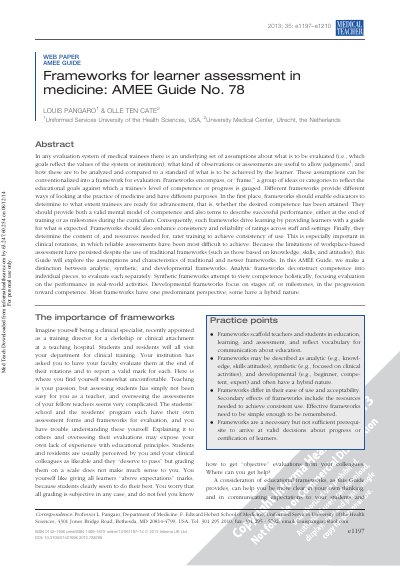

Frameworks for learner assessment in medicine: AMEE Guide No. 78 - cover page
Document type
Other
Language
English
Pages
14
File format
PDF
File size
768 KB
Published
17 November, 2023
Updated
17 November, 2023
MD5 checksum
27ACE339CCFF38C5FFA0243F18186CC3

About this manual

This AMEE Guide covers frameworks for learner assessment in medicine and explains how they shape the evaluation of trainees. It describes analytic, synthetic, and developmental frameworks and their use in clinical training and education.

The guide also discusses Miller's Pyramid, the alignment of teaching and assessment, and practical issues such as consistency, reliability, and rater training for workplace-based assessment.

What's inside

  • Abstract
  • The importance of frameworks
  • Practice points
  • Short history of major frameworks to inform teaching and assessment
  • Miller's Pyramid
  • Analytic, synthetic, and developmental frameworks

Frequently asked questions

What three types of frameworks does the guide distinguish?

It distinguishes analytic, synthetic, and developmental frameworks.

What are the four levels in Miller's Pyramid?

The levels are knows, knows how, shows how, and does.

Are frameworks sufficient by themselves for valid decisions about learners?

No, frameworks are a necessary but not sufficient prerequisite for valid decisions about progress or certification.

Download PDF (768 KB)

Also Manuals