
The DENON SC-7000 and SC-7000Z Desoldering Tool User Manual provides information on how to use and maintain the tool.
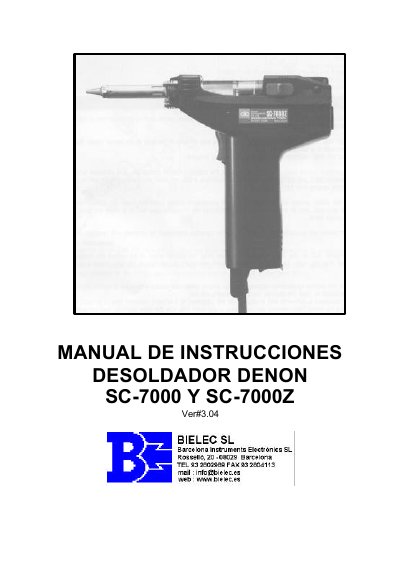
Instruction manual in Spanish for the Denon SC-7000 and SC-7000Z desoldering tools, issued by BIELEC SL in Barcelona. It explains how to work with the station: connecting it to the mains, switching it on with the switch under the handle, letting it heat up, setting the temperature, desoldering a terminal with the suction pump, and keeping the tip, filter cartridge and reservoir clean.
The rest of the document covers maintenance and repair: replacing the reservoir and filter cartridge, changing the desoldering tip and the hot-air nozzle for SMD work, cleaning or replacing the valve seat, valve and diaphragm of the suction pump, and replacing the heating resistor using a table that matches terminal colors to potentiometer VR2 positions. It ends with exploded views, a coded spare-parts list, cleaning advice (including the Chemtronics PQL106 FLUX OFF cleaner) and a warning to use only original spare parts. This manual is written in Spanish.
| Standard desoldering temperature | 380 °C to 400 °C |
|---|---|
| Multilayer board temperature range | 420 °C to 450 °C |
| Cleaning rod diameters | 0.8 mm, 1 mm and 1.5 mm |
| Filter cartridge replacement point | When one quarter to one half of the filter is discolored |
Pull the slider toward the handle to the RELEASE position, push the filter assembly in the "<" direction and take it out. Place the new cartridge with the FRONT mark facing up and return the slider to the FIX position.
For standard desoldering procedures the manual recommends 380 °C to 400 °C. For work on multilayer boards the best results are obtained between 420 °C and 450 °C.
Unblock the channel that carries the solder to the reservoir while the tool is hot, starting with the cleaning rods supplied with the station and using the rod that matches the tip hole diameter.
Smoke appears in the resistor area during the first minutes because the protective layer heats up for the first time; this layer is a mica insulator around the ceramic resistor.