
The TMCM-1060 is a single-axis stepper motor controller/driver with a rated current and voltage of 2.8A/48V, supporting USB, RS485 and CAN bus interfaces, and integrating a sensOstep™ encoder.
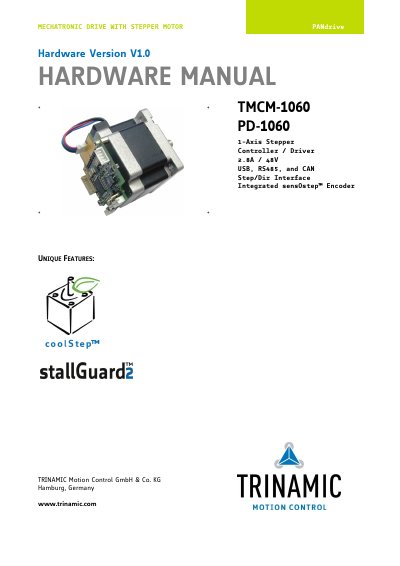
This hardware manual covers the TRINAMIC PD57/60-1060 PANdrive and the TMCM-1060 controller/driver module. The PD57/60-1060 is a mechatronic device combining a NEMA 23 (57mm flange) or NEMA 24 (60mm flange) two-phase bipolar stepper motor with controller/driver electronics and an integrated sensOstep magnetic encoder; the electronics alone is available as the TMCM-1060 module.
The manual describes features, order codes, mechanical dimensions and mounting, motor data, connectors, jumpers for RS485 and CAN bus termination, operational ratings, torque curves for each motor variant, the system architecture (ARM7 microcontroller, EEPROM, TMC262-based driver, sensOstep encoder), and TMCL standalone operation. It is intended for users integrating the drive into single-axis stepper motor applications.
| Supply voltage | +9V...+51V DC (+12V/+24V/+48V supported) |
|---|---|
| Motor current | up to 2.8A RMS (programmable) |
| Microstepping | Up to 256 microsteps per full step |
| Encoder | sensOstep magnetic encoder, max. 256 positions per rotation |
| Serial interfaces | USB (mini-USB), RS485 and CAN (2.0B up to 1Mbit/s) |
| Holding torque (57mm motor) | 0.55Nm, 1.01Nm, 1.26Nm or 1.89Nm |
| Holding torque (60mm motor) | 1.1Nm, 1.65Nm, 2.1Nm or 3.1Nm |
| TMCM-1060 module size | 60 x 60 x 15 mm |
| TMCL program memory | up to 2048 TMCL commands (non-volatile) |
Common supply voltages of +12VDC, +24VDC and +48VDC are supported, with an allowed range of +9V to +51V DC. Pre-series boards are limited to +40V max.
The board offers USB (mini-USB), RS485 and CAN (2.0B up to 1Mbit/s) serial communication interfaces, plus an optically isolated step/direction interface.
The driver is disabled in hardware as long as the shutdown input is left open or shorted to ground; for operation it should be tied to supply voltage.
Keep the electronics free of metal particles, since the encoder magnet attracts tiny metal particles that can cause shorts and erratic behavior; use compressed air for cleaning if necessary.