
This document introduces the installation and use methods of the SB static loading weight module of Ningbo Koli Sensor Technology Co., Ltd. The product has three structures of fixed, floating and semi-floating, which allows the container to produce micro deformation. It is compact in structure and does not need additional accessories. The sensor is sealed and welded, and has strong environmental adaptability. The supporting bolt prevents the equipment from tipping over and facilitates maintenance. The grounding device protects the sensor from power surge impact. The overload protection device protects the sensor from impact force.
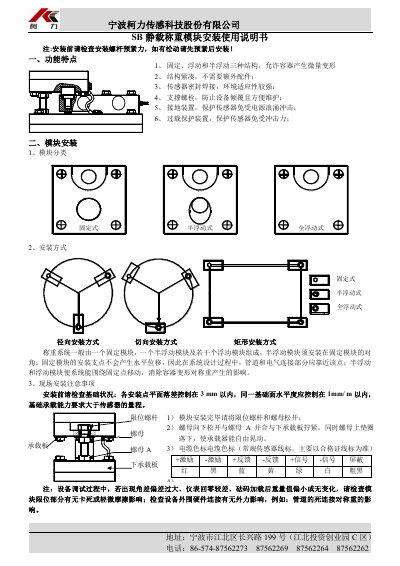
These instructions cover the Keli SB static load weighing module, a device used in weighing systems. The document describes three module types — fixed, semi-floating, and full-floating — and explains radial, tangential, and rectangular installation methods.
A typical weighing system consists of one fixed module, one semi-floating module, and several floating modules. The semi-floating module must be installed diagonally opposite the fixed module. The document also provides on-site installation requirements, wiring color codes, and troubleshooting guidance for issues such as excessive corner error or poor zero return. This manual is written in Chinese.
| Maximum plane height difference at installation points | Within 3 mm |
|---|---|
| Levelness of same foundation surface | Within 1 mm/m |
| Foundation load capacity requirement | Greater than the sensor range |
Three types are available: fixed, semi-floating, and full-floating.
A weighing system generally consists of one fixed module, one semi-floating module, and several floating modules. The semi-floating module must be installed diagonally opposite the fixed module.
Red is +excitation, black is -excitation, blue is +feedback, yellow is -feedback, green is +signal, white is -signal, and thick black is the shield.