
HG-RFSIM4-M portable GNSS signal simulator is a GNSS RF signal simulator that can be completely independent of PC. It differs from HG-SIM2 in that its hardware is based on high-performance SOC technology, and it does not need external device computing power to work properly. HG-RFSIM4-M comes with a TF card, and most settings can be set via TF card, which is easy to use. HG-RFSIM4-M can set some parameters during running via RS485 interface. Simple serial debug assistant, Raspberry Pi, or a simple STM32 processor can realize normal operation of the simulator.
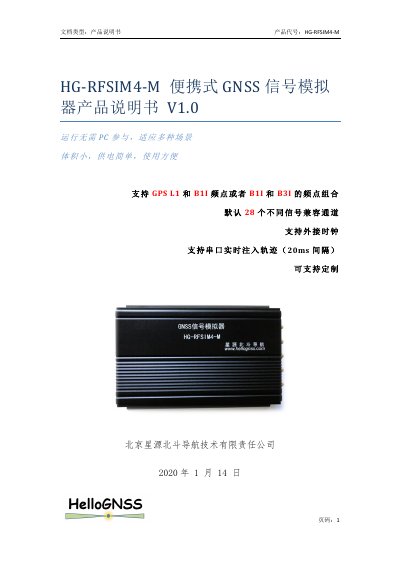
This is the V1.0 product manual (产品说明书) for the HG-RFSIM4-M portable GNSS signal simulator from Beijing Xingyuan Beidou Navigation Technology Co., Ltd. (星源北斗), dated January 14, 2020. The document introduces the simulator, lists the two standard configurations (HG-RFSIM4-M-L1B1 for GPS L1 and BD B1I, and HG-RFSIM4-M-B1B3 for BD B1I and B3I), and shows front panel, rear panel and hardware photographs.
The manual explains that the simulator works without a PC because its hardware is based on SOC technology, uses a TF card for most settings, and can be controlled over RS485 or fed trajectories over RS232. It also describes the HG-TG04-C/D reference receiver and HG-ANT03 full-frequency antenna supplied with the unit, gives the main specifications, the packing list, and the service terms covering replacement, warranty and software use. This manual is written in Chinese.
| RF output channels | 2, SMA connectors |
|---|---|
| Signal channels | No fewer than 28 |
| RF chip maximum attenuation | 47 dB |
| External attenuators | 2 stages of 32 dB |
| Total hardware attenuation | 62 dB |
| Digital attenuation range | 30 dB |
| On-board clock | 16.369 MHz default, 0.5 ppm stability |
| Power supply | External +5 V |
| Control and data interfaces | RS485 control, CAN to reference receiver, RS232 trajectory injection |
| Dimensions | Length under 20 cm, width 13 cm, height 3 cm |
| D/A output | 8 to 12 bit |
No. It is a GNSS RF signal simulator that can work completely without a PC, since its hardware is based on SOC technology and most settings are made through a TF card.
It only needs an external +5 V supply; a 2 A mobile phone charger is enough to run it.
Trajectories can be injected in real time through the RS232 serial port at an interval as short as 20 ms.
One HG-RFSIM4-M signal simulator, one HG-TG04-C/D receiver, one HG-ANT03 full-frequency antenna, one 5V 2A power supply, and the documentation including the RS232 trajectory injection example.