
This document provides guidance on West Nile virus mosquito control methods, including how to control mosquito larvae and adults
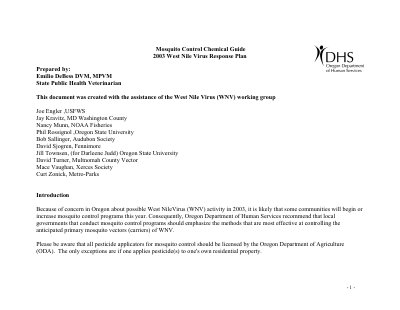
This document is the Mosquito Control Chemical Guide from the 2003 West Nile Virus Response Plan, prepared by Emilio DeBess, DVM, MPVM, State Public Health Veterinarian with the Oregon Department of Human Services and created with the assistance of a West Nile Virus (WNV) working group. It was issued because of concern about possible West Nile Virus activity in Oregon in 2003, and it recommends that local governments conducting mosquito control programs emphasize the methods most effective against the anticipated primary WNV mosquito vectors.
The guide explains why control of Culex spp. larvae is the priority, recommends treating catch basins at least three times during the summer, and covers adulticiding (fogging) and non-chemical measures such as removing standing water. It lists larvicide and adulticide products registered for use in Oregon, including Vectolex, Altosid, Vectobac, Aquabac, Pyrenone, Anvil, Aqua Reslin, Permanone, Scourge, Fyfanon, Malathion ULV, Atrapa and Dibrom, with tables comparing active ingredients, label rates, setbacks and toxicity. It also states that mosquito control pesticide applicators must be licensed by the Oregon Department of Agriculture.
| Pyrethrins soil half life | 12 days |
|---|---|
| Permethrin, resmethrin and sumithrin soil half life | 30 days |
| Adulticiding application conditions | 60 to 85 degrees Fahrenheit and low wind speeds |
| Fyfanon ULV malathion content | 96.5% |
All pesticide applicators for mosquito control should be licensed by the Oregon Department of Agriculture, except people applying pesticides to their own residential property.
Larviciding, the treatment of locations where mosquito larvae are present such as the water in catch basins, is described as the most effective method of mosquito control.
The Department recommends treating catch basins at least three times during the summer, in June, July and August.
Only when mosquitoes are most active, usually evening or early morning, and under appropriate environmental conditions such as temperatures from 60 to 85 degrees Fahrenheit and low wind speeds.