
This manual provides a detailed description of the process of producing buffalo mozzarella cheese, including preparation of raw materials, coagulation, cutting of curd, maturation, stretching, shaping, salting, packaging and sale. It also provides detailed step-by-step instructions and pictures for each process.
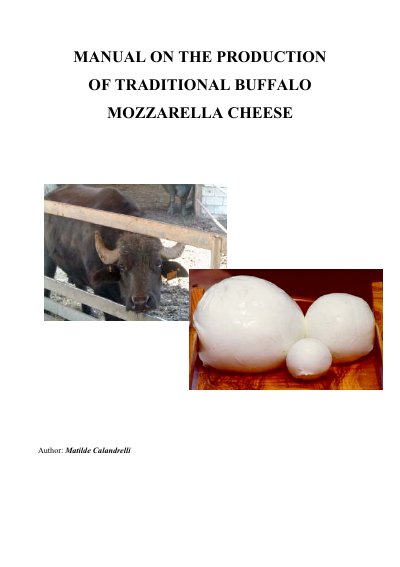
This manual, written by Matilde Calandrelli, is an educational text on the production of traditional buffalo Mozzarella cheese. It opens with the properties of milk and buffalo milk in particular, the microbiology of dairy micro-organisms, and a general outline of how cheese is produced, before moving into the world of stretched curd (pasta filata) cheeses.
The core chapter details the buffalo Mozzarella technology stage by stage: the raw material and its acidity, coagulation, cutting of the curd, maturation under whey, stretching, shaping or "mozzatura", salting, dairy yield, packaging and sale, and smoking, with a numeric example. Later chapters cover technological problems and defects, ricotta cheese, the dairy itself, and a glossary of terms.
| Buffalo milk water content | 82.2% |
|---|---|
| Buffalo milk protein content | 4.8% |
| Buffalo milk fat content | 7.5% |
| Buffalo milk lactose content | 4.7% |
| Buffalo milk mineral salts content | 0.8% |
Buffalo cows are milked twice a day for 10 months, a period known as the lactation period.
By the lacto-fermentation test: 10 ml of milk in a test tube kept at about 30-37°C for 24 hours (48 hours for ewe's milk), then the curdle is read for homogeneity, bubbles and smells.
Acidity, created by lactic bacteria, is the most important parameter: without the right degree of acidity the liquid mass will not string and buffalo Mozzarella cannot be produced.
Coagulation can be by rennet, by acid (milk left to sour until pH = 4.6), or mixed (acid with a small quantity of rennet).