
This manual introduces technical knowledge related to constant volume dampers and actuators, including actuators' control points, maximum torque requirements, hysteresis, accuracy, etc.
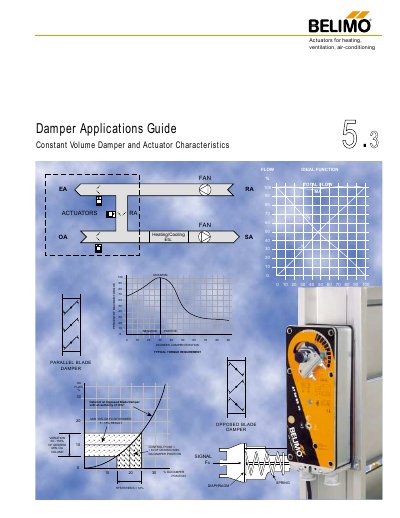
This Belimo Damper Applications Guide discusses constant volume damper and actuator characteristics in heating, ventilation and air-conditioning systems. It explains economizer systems, indoor air quality, and how damper selection and actuator accuracy affect control.
The guide covers parallel and opposed blade dampers, inherent and installed flow characteristics, damper authority, combined flow, hysteresis, accuracy, pneumatic and electronic actuators, positioners, torque, linkage, sizing, linearization, range controllers, and modernization of old installations.
| Damper types | Parallel blade and opposed blade |
|---|---|
| Hysteresis | 12% |
| Control point accuracy | ±6° of desired minimum OA damper position |
| Minimum outside air flow | 10% |
| Desired minimum OA flow range | 5–15% |
| Variation from desired minimum OA volume | 50–150% |
| Damper authority example | 10% |
Parallel blade dampers have all blades moving in the same direction and in parallel. Opposed blade dampers have adjacent blades moving in opposite directions.
A realistic damper authority is much lower than 100%; the guide gives 1–10% as an example.
The economizer will not function correctly, and indoor air quality and comfort are compromised.
They reduce operating cost and must provide enough outside air for good indoor air quality; they also affect building pressurization.