
The IQS-500 Intelligent Test System is designed to meet the requirements of automation and promote integration with the test environment. This document will describe how to integrate the IQS-500 into your own test environment. Configuration descriptions will help you understand the concepts and techniques behind the EXFO method.
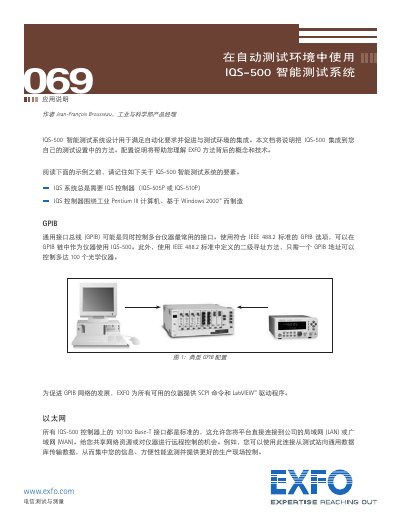
This EXFO application note (number 069) describes ways to integrate the IQS-500 Intelligent Test System into your own automated test environment. It notes that an IQS controller (IQS-505P or IQS-510P), built around an industrial Pentium III computer running Windows 2000, is always required, and it explains the concepts behind EXFO's configuration methods.
The note covers GPIB (IEEE 488.2, including secondary addressing for up to 100 optical instruments), the standard 10/100 Base-T Ethernet interface for LAN/WAN connection and remote control via DCOM libraries, RS-232 with null modem cabling (EXFO part number GP-216) and its pinout, local ActiveX applications, and use of the IQS controller as a system manager for third-party instruments. This manual is written in Chinese.
| Required controller | IQS-505P or IQS-510P |
|---|---|
| Controller computer | Industrial Pentium III computer |
| Controller operating system | Windows 2000 |
| Controller processor | Pentium III 866 MHz |
| Ethernet interface | 10/100 Base-T (standard on all IQS-500 controllers) |
| Maximum optical instruments per GPIB address | Up to 100 |
| Null modem cable part number | EXFO GP-216 |
An IQS controller is always required, either the IQS-505P or the IQS-510P.
Using the IEEE 488.2 secondary addressing method, a single GPIB address can control up to 100 optical instruments.
Because the IQS-510P uses DTE/DTE communication, a null modem cable must be used; the document lists EXFO part number GP-216.
The IQS controller has a Pentium III 866 MHz processor.