
CHIRAL ART Cellulose-SC is a new product from YMC, which is a silica-based chiral stationary phase for optical isomer separation. It has excellent separation performance and high selectivity, and it is suitable for most chiral compounds.
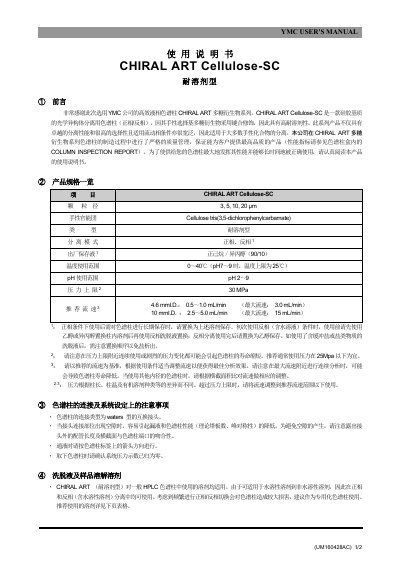
This user manual provides detailed instructions for operating and maintaining the YMC CHIRAL ART Cellulose-SC chiral HPLC column. It covers product specifications, solvent compatibility for normal and reverse-phase separations, storage conditions, and cleaning procedures. The column is designed for high solvent resistance and broad pH compatibility, suitable for most chiral compounds. Users are advised to follow recommended flow rates and solvent transitions to avoid column damage.
The manual includes precautions for connecting the column, handling solvents, and sample preparation. It also provides recommended solvents and additives for both normal and reverse-phase modes, along with guidelines for column cleaning and troubleshooting. Users are advised to contact the distributor if the product is damaged or does not match the order. This manual is written in Chinese.
| Particle Size | 3, 5, 10, 20 µm |
|---|---|
| Chiral Group | Cellulose tris(3,5-dichlorophenylcarbamate) |
| Type | Solvent-resistant type |
| Separation Mode | Normal phase, Reverse phase |
| Storage Solution | Hexane/isopropanol (90/10) |
| Temperature Range | 0~40℃ (pH 7~9, max 25℃) |
| pH Range | pH 2~9 |
| Pressure Limit | 30 MPa |
| Recommended Flow Rate | 4.6 mmI.D.: 0.5~1.0 mL/min (max 3.0 mL/min); 10 mmI.D.: 2.5~5.0 mL/min (max 15 mL/min) |
It is compatible with both water-soluble and non-water-soluble solvents, suitable for both normal and reverse-phase separations. Recommended solvents are listed in the manual.
Increase the polarity of the eluent or use 100% ethanol for cleaning. If performance does not improve, use ethyl acetate for 10x column volume or more. For columns with additives, use 30x column volume.