
A combination antitumor formulation comprising tetrandrine (TET), quercetin (QUE) or dihydroquercetin (DHQ) and a tyrosine kinase inhibitor, preferably third-generation tyrosine kinase inhibitor, more preferably osimertinib (OSI) or ametinib (ALM) is provided. In preferred embodiments, the formulation is effective against non-small cell lung cancer and more preferably, EGFR-mutant-driven tyrosine kinase inhibitor-resistant non-small cell lung cancer.
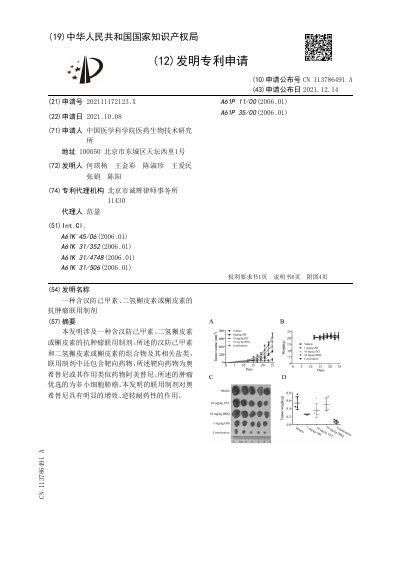
Chinese patent application CN 113786491 A, filed on 8 October 2021 and published on 14 December 2021, was submitted by the Institute of Medicinal Biotechnology, Chinese Academy of Medical Sciences, with He Qiyang, Wang Jincai, Chen Shuzhen, Wang Aimin, Zhang Juan and Chen Yang named as inventors. It describes antitumor combination formulations containing a therapeutically effective amount of tetrandrine (TET) or its salts, a flavonol or dihydroflavonol such as quercetin (QUE) or dihydroquercetin (DHQ) or their salts, a tyrosine kinase inhibitor — preferably a third-generation inhibitor such as osimertinib (OSI) or almonertinib (ALM) — and necessary pharmaceutical excipients.
The claims cover two- and three-component combinations, the use of TET, QUE or DHQ in preparing such combination formulations, and an embodiment with 1%–80% tetrandrine, 1%–80% dihydroquercetin and osimertinib, preferably in a 10:10:1 mass ratio. The preferred tumor is a lung tumor, more preferably non-small cell lung cancer, and most preferably EGFR-mutation-driven, tyrosine kinase inhibitor-resistant non-small cell lung cancer. The document states that the combination markedly enhances osimertinib and reverses resistance; it runs 12 pages, with 1 page of claims, 6 pages of description and 4 pages of drawings. This manual is written in Chinese.
| Tetrandrine mass proportion in the formulation | 1%–80% |
|---|---|
| Dihydroquercetin mass proportion in the formulation | 1%–80% |
| Preferred mass ratio tetrandrine : dihydroquercetin : osimertinib | 10 : 10 : 1 |
| Preferred tumor type | Non-small cell lung cancer, preferably EGFR-mutation-driven TKI-resistant |
| Approved daily intake of dihydroquercetin as a new food raw material | No more than 100 mg per day |
It contains a therapeutically effective amount of tetrandrine or its salts, a flavonol or dihydroflavonol such as quercetin or dihydroquercetin, a tyrosine kinase inhibitor, and necessary pharmaceutical excipients.
The patent names the third-generation inhibitors osimertinib (OSI) and almonertinib (ALM).
The preferred tumor is a lung tumor, preferably non-small lung cancer, most preferably EGFR-mutation-driven tyrosine kinase inhibitor-resistant non-small cell lung cancer.
Tetrandrine : dihydroquercetin : osimertinib at 10 : 10 : 1.