
Hanbeta® (bevacizumab) is a biosimilar to Avastin® (bevacizumab) developed by Fosun Pharma, and is indicated for the treatment of metastatic colorectal cancer, advanced, metastatic or recurrent non-small cell lung cancer, recurrent glioblastoma, hepatocellular carcinoma, etc.
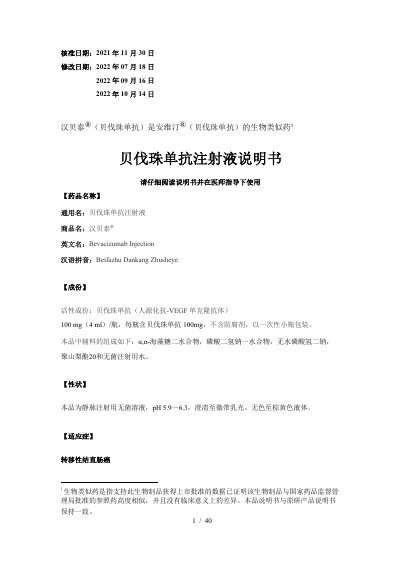
This is the Chinese instructions for use (package insert) for Hanbeta® (bevacizumab) injection, described in the text as a biosimilar of Avastin® (bevacizumab). The document gives the product name, composition, description, indications, strength and dosage and administration information. Its header lists an approval date of November 30, 2021 and later revision dates.
The text details intravenous infusion dosing for metastatic colorectal cancer, advanced, metastatic or recurrent non-squamous non-small cell lung cancer, recurrent glioblastoma and hepatocellular carcinoma, together with special dose instructions for children, elderly patients and patients with renal or hepatic impairment. It also covers handling, dilution and disposal of the product, situations requiring dose interruption or permanent discontinuation, and adverse drug reactions reported in clinical trials. This manual is written in Chinese.
| Strength | 100 mg (4 ml) per vial, 25 mg/ml, 4 ml fill volume |
|---|---|
| Active ingredient | Bevacizumab (humanized anti-VEGF monoclonal antibody) |
| pH | 5.9 to 6.3 |
| Appearance | Clear to slightly opalescent, colorless to brownish-yellow liquid |
| Excipients | α,α-trehalose dihydrate, sodium dihydrogen phosphate monohydrate, anhydrous disodium hydrogen phosphate, polysorbate 20, sterile water for injection |
| Final concentration after dilution | 1.4–16.5 mg/ml |
The first intravenous infusion must last 90 minutes. If it is well tolerated, the second infusion can be shortened to 60 minutes and subsequent infusions to 30 minutes.
In combination with chemotherapy, 5 mg/kg body weight once every two weeks or 7.5 mg/kg once every three weeks.
No. The bevacizumab infusion must not be given at the same time as, or mixed with, dextrose or glucose solutions.
Health professionals use sterile technique to withdraw the required amount and dilute it with 0.9% sodium chloride solution to the required administration volume.