
The document introduces a kit for extracting and purifying genomic DNA from cells, blood and tissues.
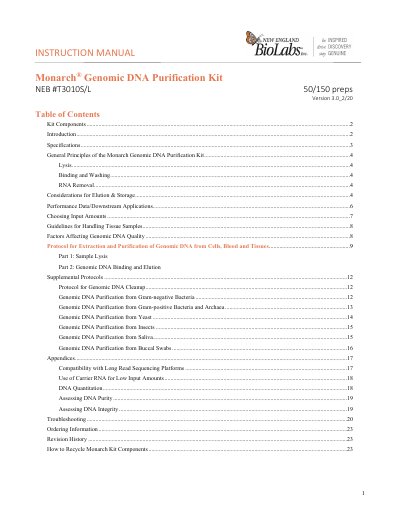
This manual provides detailed protocols for extracting and purifying genomic DNA from a wide range of biological samples, including cultured cells, blood, tissues, bacteria, yeast, saliva, and buccal swabs. It includes optimized lysis buffers for different sample types, binding and washing steps, RNA removal options, and elution guidelines. The kit is designed for high-purity DNA with minimal RNA contamination, suitable for downstream applications like PCR, qPCR, and long-read sequencing.
The manual also includes supplemental protocols for specific sample types, troubleshooting tips, and guidance on storage and handling to maintain DNA integrity and yield.
| Input Sample Types | Cultured mammalian cells: up to 5 x 10^6 cells; Mammalian whole blood: 100 µl; Tissue: up to 25 mg; Bacteria: up to 2 x 10^9; Yeast: up to 5 x 10^7; Saliva: up to 500 µl; Buccal swabs |
|---|---|
| Binding Capacity | 30 µg genomic DNA |
| Genomic DNA Size | Peak size > 50 kb for most sample types; may be lower for saliva and buccal swabs |
| RNA Content | < 1% (with included RNase A treatment) |
| Purity | A260/280 ≥ 1.8, A260/230 ≥ 2.0 |
The recommended elution volume is 100 µl. Using volumes between 35–100 µl yields optimal recovery, with 100 µl providing 80–85% recovery in the first elution.
Purified gDNA can be stored at 4–8°C for weeks to months, or at -20°C for long-term storage. Avoid repeated freeze-thaw cycles to prevent DNA degradation.
Inclusion of RNase A treatment results in best-in-class residual RNA levels of 0–1%, which require sophisticated detection methods like LC-MS.
Elution should be performed with preheated elution buffer to 60°C to improve efficiency, especially for larger DNA molecules. Temperatures above 60°C may cause irreversible denaturation.