
The Prohibition of Employment as Manual Scavengers and their Rehabilitation Act, 2013 (MS Act, 2013) has been in force since 2013, prohibiting insanitary latrines, manual scavenging and hazardous cleaning of sewers and septic tanks. The Act provides for fines and imprisonment for non-compliance.
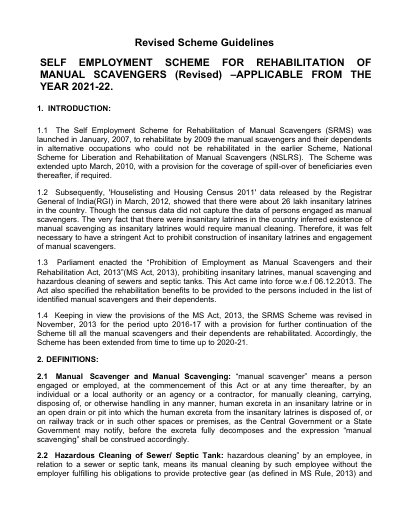
This document outlines the Revised Scheme Guidelines for the Self Employment Scheme for Rehabilitation of Manual Scavengers (SRMS), applicable from the year 2021-22. It details the rehabilitation measures for manual scavengers and their dependents, including one-time cash assistance, skill development training, and health insurance coverage under the Ayushman Bharat Pradhan Mantri-Jan Arogya Yojana (AB-PMJAY).
The guidelines specify financial assistance for self-employment projects, including loan limits, interest rates, and credit-linked up-front capital subsidies. It also covers the organization of behavior training, awareness camps, and workshops to sensitize sanitation workers and officials regarding safety norms and mechanized cleaning practices.
| One Time Cash Assistance (OTCA) | Rs. 40,000/- |
|---|---|
| Skill Training Stipend | Rs. 3000/- per month |
| Maximum Loan for Individuals | Rs. 15 lakhs |
| Maximum Loan for Groups | Rs. 50 lakh |
| Interest Rate (Projects up to Rs. 100,000) | 5% per annum (4% for women) |
| Interest Rate (Projects above Rs. 100,000) | 6% per annum |
| Repayment Period (Projects above Rs. 500,000) | 7 years |
| Capital Subsidy (Individuals up to Rs. 500,000) | 50% of project cost |
One Time Cash Assistance (OTCA) is Rs. 40,000/- or any such amount as revised from time to time.
A monthly stipend of Rs. 3000/- is remitted directly into the trainee's bank account for the entire training period subject to fulfilling minimum attendance.
Loans up to a maximum project cost of Rs. 15 lakhs are admissible to identified manual scavengers and their dependents.
The repayment period is five years for projects up to Rs. 500,000, with a moratorium period of up to 6 months.