
This appendix provides examples of reportable malignant tumors as referenced in the Reportability instructions of the 2021 SEER Program Coding and Staging Manual. These examples illustrate how to determine reportable malignancies based on the 2021 SEER Program Coding and Staging Manual Reportability instructions.
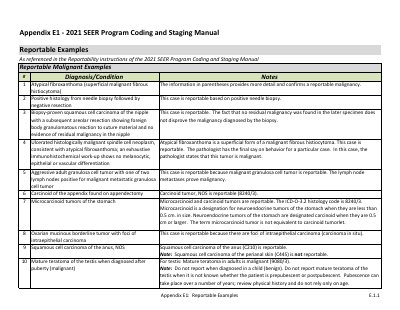
This document serves as an appendix to the 2021 SEER Program Coding and Staging Manual, providing specific examples of diagnoses and conditions. It details which cases are considered reportable malignancies based on positive histology, specific tumor types, and imaging criteria such as LI-RADS and PI-RADS categories.
The text also includes a section on non-reportable examples, clarifying conditions that are benign, have uncertain malignant potential, or lack definitive diagnostic criteria for reporting under the SEER program. It references specific ICD-O-3 codes and WHO classifications to guide data entry.
Yes, atypical fibroxanthoma (superficial malignant fibrous histiocytoma) is a reportable malignancy.
No, they are only reportable if diagnosed after puberty; they are not reportable if diagnosed in a child.
No, squamous cell carcinoma of the perianal skin (C445) is not reportable, unlike squamous cell carcinoma of the anus (C210).
No, LAMN is designated with /1 with uncertain malignant potential and is not reportable.