
This is a product manual for an automatic mains failure module, which includes instructions for use, operation methods, installation references, etc.
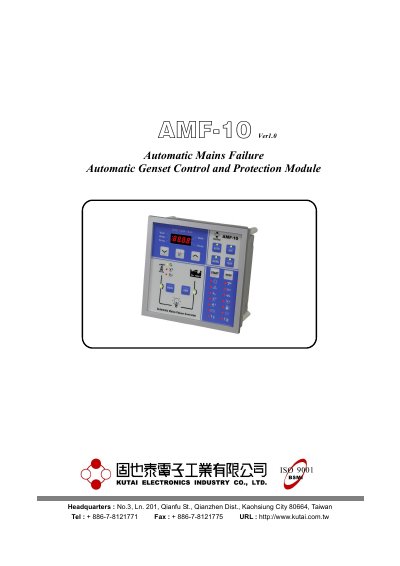
The AMF-10 is an automatic mains failure module designed to monitor and protect against power loss by controlling emergency generators and transfer switches. It features a front panel with four operational modes: Auto, Manual, Test, and Shutdown. The module displays AC voltage, current, frequency, engine hours, and battery voltage. It includes protection functions for over/under voltage, missing phases, engine overloads, and low oil pressure. The manual details installation, operation modes, system settings, and failure handling procedures.
The AMF-10 can be programmed directly from the front panel without a computer. It supports automatic transfer between normal and emergency power, with configurable time delays for engine startup, idle, and cooldown. It also provides alarm and warning signals for system failures and includes two user-configurable inputs for custom monitoring.
| Operating Modes | Auto, Manual, Test, Shutdown |
|---|---|
| Display | 4 digital, 7-segment displays |
| Engine Start Attempts | Up to 9 times |
| Preheat Countdown | Displayed in seconds 【PH.XX】 |
| Starter Motor Run Time | 6 seconds (adjustable up to 30 seconds) |
| Grace Period After Engine Start | 30 seconds |
When the AMF-10 detects abnormal voltage or missing phase from the normal power source, it automatically starts the generator and transfers power to the emergency source via the transfer switch.
The AMF-10 has four operational modes: Auto, Manual, Test, and Shutdown. Each mode is controlled by a dedicated button on the front panel.
The AMF-10 monitors engine oil pressure, coolant temperature, and speed, and provides protection against over/under speed, low oil pressure, and high coolant temperature.
Yes, the AMF-10 can be programmed directly from the front panel using its built-in interface, and settings are saved in internal EEPROM.