
InBT-UART is a Bluetooth adapter developed by Biospace. It can be connected to the InBody (Body composition analyzer) and BPBIO (Blood pressure monitor) via UART interface, and supports data communication between them and a PC.
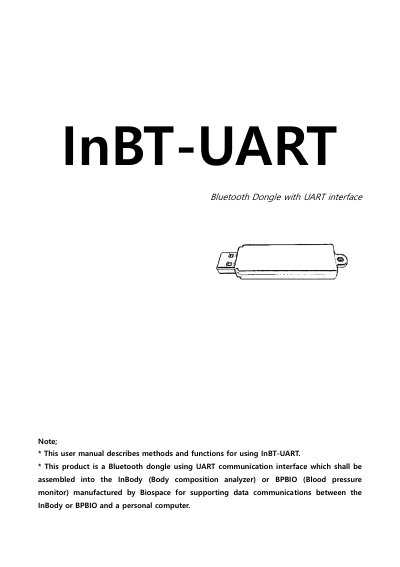
This user manual describes the InBT-UART Bluetooth dongle, which enables UART-based communication between InBody and BPBIO devices and a personal computer. It supports Bluetooth 2.1 + EDR with features like adaptive frequency hopping to reduce interference with WiFi. The dongle requires a UART-enabled processor for operation and uses default settings of 115200 bps, 8 data bits, 1 stop bit, no parity, and no flow control. Commands like AT, SET, INQUIRY, CALL, and SET RESET are used to configure and control the device.
| Bluetooth Version | 2.1 + EDR, Class 1 |
|---|---|
| Frequency Band | 2.4GHz ISM band |
| Operation Range | 200-400m |
| Transmission Strength | +13 dBm |
| Reception Sensitivity | -86 dBm |
| Default Baud Rate | 115200 bps |
| Data Bits | 8 |
| Stop Bits | 1 |
| Parity Bit | No parity |
| Hardware Flow Control | Disable |
The default UART settings are 115200 bps, 8 data bits, 1 stop bit, no parity, and no flow control.
InBT-UART supports Bluetooth 2.1 + EDR, Class 1.
It uses Adaptive Frequency Hopping (AFH) to automatically select communication channels not used by WiFi signals.