
Operating Instructions for the 8222 ELEMENT conductivity meter
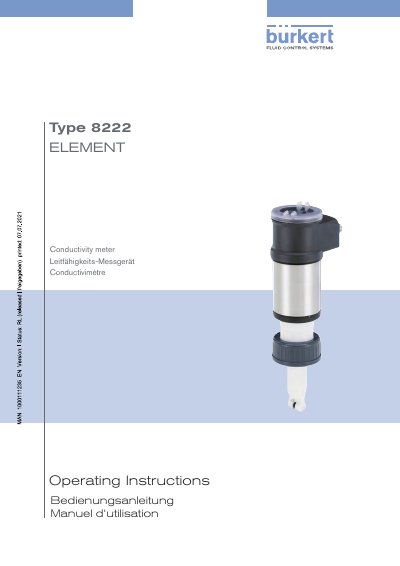
This manual provides detailed operating instructions for the Bürkert 8222 ELEMENT conductivity meter, including safety precautions, installation procedures, calibration, and troubleshooting. It covers device construction, sensor specifications, wiring, and configuration of outputs. The device measures conductivity in liquids and can control solenoid valves or alarms via transistor outputs and 4...20 mA current outputs. Safety warnings address electrical, pressure, and fluid hazards. The manual also includes contact information and warranty details.
| Sensor Material | Stainless steel (C=0.01 or 0.1) or graphite (C=1.0) |
|---|
The device is intended for the measurement of conductivity in liquids, and it can be used to switch a solenoid valve, activate an alarm, or establish control loops.
This specific device variant requires a power supply of 14...36 V DC.
This specific device variant requires a power supply of 12...36 V DC.