
EFM8 Laser Bee Family EFM8LB1 Reference Manual This document introduces the features of the EFM8LB1 microcontroller, including the 8051 core, 14-bit ADC, internal calibrated temperature sensor (±3 °C), and four 12-bit DACs.
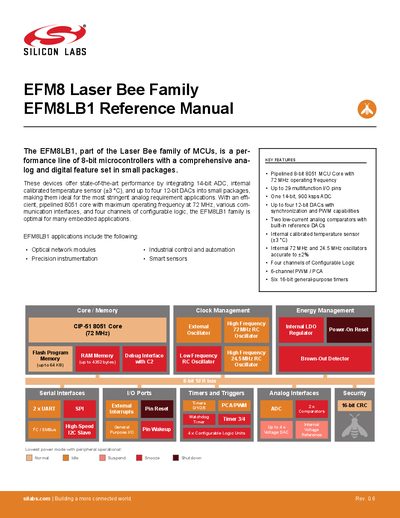
This document is a technical reference manual for the EFM8LB1, part of the Laser Bee family of 8-bit microcontrollers. It details the device's comprehensive feature set, including a pipelined 8051 core with a maximum operating frequency of 72 MHz, integrated analog and digital peripherals, and various communication interfaces.
The manual provides in-depth information on system architecture, memory organization, special function registers, and specific peripheral modules such as the ADC, DACs, comparators, configurable logic units, timers, and power management features. It serves as a comprehensive resource for developers designing embedded applications using this microcontroller.
| Operating Frequency | 72 MHz |
|---|---|
| ADC Resolution | 14-bit |
| DAC Channels | up to four 12-bit DACs |
| Flash Program Memory | up to 64 KB |
| RAM Memory | up to 4352 bytes |
| I/O Pins | Up to 29 multifunction I/O pins |
The maximum operating frequency for the pipelined 8051 core is 72 MHz.
The device supports up to 64 KB of Flash Program Memory.