
Instrumentation amplifiers are precision differential voltage gain devices optimized for environments that are not conducive to precision measurements. They feature high input impedance, low bias and offset currents, balanced differential inputs, and high common mode rejection.
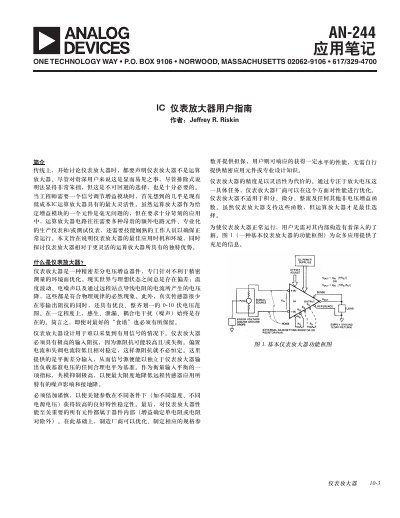
The document introduces the concept of instrumentation amplifiers (IAs) as precision differential voltage gain devices optimized for environments where precise measurements are difficult. It contrasts them with standard operational amplifiers, highlighting that while op-amps offer flexibility, IAs provide superior performance in terms of input impedance, bias current stability, and common-mode rejection without requiring external precision components.
The text details the internal architectures of instrumentation amplifiers, categorizing them into designs based on multiple operational amplifiers (such as the popular 3-op-amp configuration) versus those using basic active circuit elements like differential circuits and controlled current sources. It provides mathematical derivations for gain equations in various configurations. This manual is written in Chinese.
Instrumentation amplifiers are precision differential voltage gain devices optimized for difficult signal acquisition environments, offering high input impedance and excellent common-mode rejection without needing external precision components.
Simple op-amp circuits often require multiple expensive extra components and skilled staff to ensure normal operation, whereas IAs optimize performance specifically for voltage gain tasks.
The most popular configuration is the 'classic' 3-op-amp design, which allows for unlimited gain at the front end without increasing common-mode error signals.