
This document introduces the principle and usage of the Kaiji One-step TUNEL Cell Apoptosis Detection Kit. The kit features high sensitivity, rapidity, and simplicity, and can be used to detect the fragmentation of cellular nuclear DNA during apoptosis. It is suitable for apoptosis in situ detection of tissue samples and cell samples.
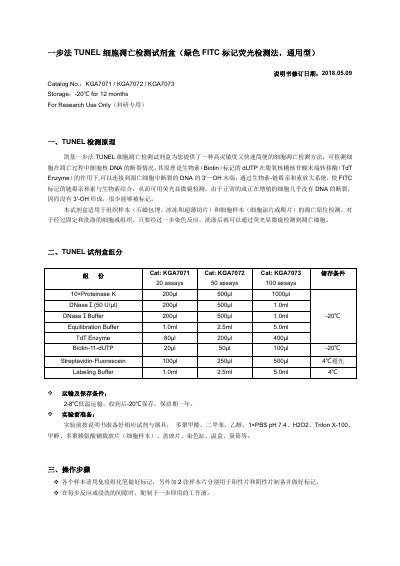
The Kaiji One-Step TUNEL Cell Apoptosis Detection Kit offers a high-sensitivity and rapid method for detecting cell apoptosis by identifying DNA breaks in apoptotic cells. The kit utilizes a biotin-labeled dUTP system amplified by a biotin-streptavidin system for fluorescence detection, suitable for both tissue sections and cell smears. This manual is written in Chinese.
| Storage Temperature | -20°C |
|---|---|
| Shelf Life | 12 months |
| Excitation Wavelength | 450-500nm |
| Emission Wavelength | 515-565nm |
| Kit Sizes | 20, 50, or 100 assays |
The method detects DNA breaks in apoptotic cells by connecting biotin-labeled dUTP to the 3'-OH ends of broken DNA using TdT enzyme, followed by fluorescence detection via a biotin-streptavidin system.
The kit is suitable for detecting apoptosis in tissue samples (paraffin-embedded, frozen, and ultra-thin sections) and cell samples (cell smears or coverslips).
The excitation wavelength is 450-500nm, and the emission wavelength is 515-565nm.