
This document introduces a bioluminescent reagent produced by UElandy Inc. for detecting total nitric oxide content. The reagent is based on the principle of the Griess reaction, which reduces nitrate to nitrite for measuring nitric oxide content.
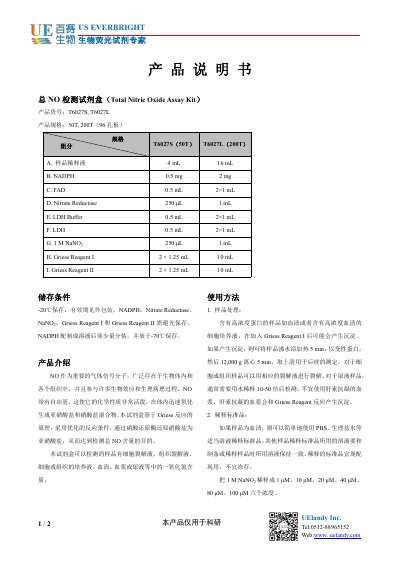
The UElandy Total Nitric Oxide Assay Kit (product numbers T6027S and T6027L) is designed for the detection of nitric oxide (NO) content in cell lysates, tissue lysates, culture media, serum, plasma, or urine. The kit operates based on the Griess reaction principle, utilizing nitrate reductase to reduce nitrate to nitrite for total NO measurement. It is intended for research purposes only. This manual is written in Chinese.
| Product Numbers | T6027S, T6027L |
|---|---|
| Kit Sizes | 50T, 200T (96-well plate) |
| Storage Temperature | -20°C |
| Sample Volume Limit | 60μL |
| Detection Wavelength | 540nm (or 520-560nm) |
The kit can detect nitric oxide in cell lysates, tissue lysates, culture media, serum, plasma, or urine.
After dissolving, NADPH must be aliquoted and stored at -70°C.
Place the reagent in a 37°C water bath until the precipitate dissolves.
No, Heparin-anticoagulated plasma should not be used as it reacts with Griess Reagent to form precipitate.