
This document describes the features and characteristics of a series of electrodes, including their applicability in measuring the conductivity, total dissolved solids, salinity, and resistivity of solutions. It also provides instructions for electrode maintenance and measurement procedures.
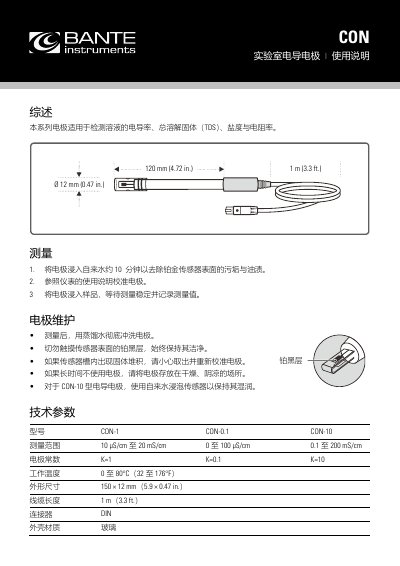
The Bante Instruments CON series electrodes are designed to measure solution parameters including conductivity, Total Dissolved Solids (TDS), salinity, and resistivity. The document outlines a three-step measurement process: immersing the sensor in tap water for ten minutes to clean it, calibrating according to instrument instructions, and then measuring the sample. This manual is written in Chinese.
| Measurement Range | 0.1 to 200 mS/cm |
|---|---|
| Operating Temperature | 0 to 80°C (32 to 176°F) |
| Connector Type | DIN |
Immerse the electrode in tap water for about ten minutes to remove dirt and oil from the platinum sensor surface.
Use the formula K = (Cstd / Cmeas) × G, where Cstd is the standard solution conductivity, Cmeas is the measured value, and G is the original electrode constant.
Store the electrode in a dry and cool place. For the CON-10 model, soak the sensor in tap water to keep it moist.