
The LIS33DE is an ultra compact low-power three axis linear accelerometer belonging to the “nano” family of ST motion sensors. It includes a sensing element and an IC interface able to provide the measured acceleration to the external world through I2C/SPI serial interface. The sensing element is manufactured using a dedicated process developed by ST to produce inertial sensors and actuators in silicon. The IC interface is manufactured using a CMOS process that allows to design a dedicated circuit which is trimmed to better match the sensing element characteristics. The LIS33DE has dynamically user selectable full scales of ±2g/±8g and it is capable of measuring accelerations with an output data rate of 100 Hz or 400 Hz. A self-test capability allows the user to check the functioning of the sensor in the final application. The device may be configured to generate inertial wake-up/free-fall interrupts, or to be used in combination with a low-pass filter to generate a 2-bit activity indicator.
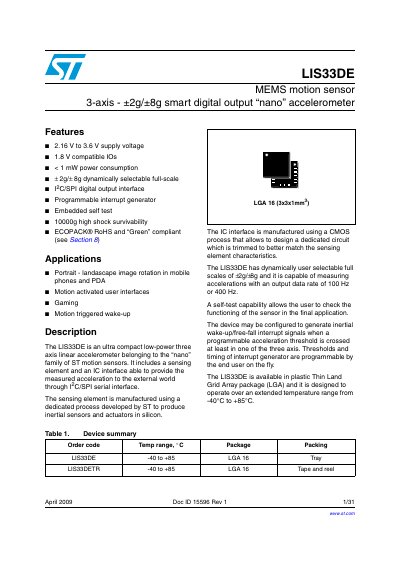
The LIS33DE is an ultra-compact, low-power three-axis linear accelerometer belonging to the 'nano' family of ST motion sensors. It utilizes a dedicated silicon process for the sensing element and a CMOS process for the IC interface, allowing for precise measurement of acceleration in portrait and landscape orientations for mobile phones, PDAs, and gaming devices.
The device offers dynamically selectable full-scale ranges of ±2g and ±8g with an output data rate of 100 Hz or 400 Hz. It features a programmable interrupt generator for wake-up and free-fall detection, an embedded self-test capability, and operates over an extended temperature range from -40°C to +85°C in a 3x3x1mm LGA 16 package.
| Supply voltage | 2.16 V to 3.6 V |
|---|---|
| Power consumption | < 1 mW |
| Full-scale ranges | ±2g / ±8g |
| Operating temperature | -40°C to +85°C |
| Package type | LGA 16 (3x3x1mm) |
| Shock survivability | 10000g |
The device supports dynamically selectable full-scale ranges of ±2g and ±8g.
Yes, it includes an embedded self-test capability to check the functioning of the sensor.