
SEA05 is a highly integrated solution for SMPS applications that require a dual control loop to perform CV (constant voltage) and CC (constant current) regulation. The device integrates a voltage reference, two op-amps (with OR-ed open-drain outputs), and a low- side current sensing circuit. The voltage reference, along with one op-amp, is the core of the voltage control loop; the current sensing circuit and the other op-amp make up the current control loop. The external components needed to complete the two control loops are: a resistor divider that senses the output of the power supply and fixes the voltage regulation setpoint at the specified value; a sense resistor that feeds the current sensing circuit with a voltage proportional to the dc output current; this resistor determines the current regulation setpoint and must be adequately rated in terms of power dissipation; the frequency compensation components (R-C networks) for both loops. The device, housed in one of the smallest available SOT23-6L packages, consumes extremely low power (200µA) and features a voltage reference accuracy of +/- 0.5%, making it suitable for applications such as battery chargers, AC-DC adapters, and LED drivers.
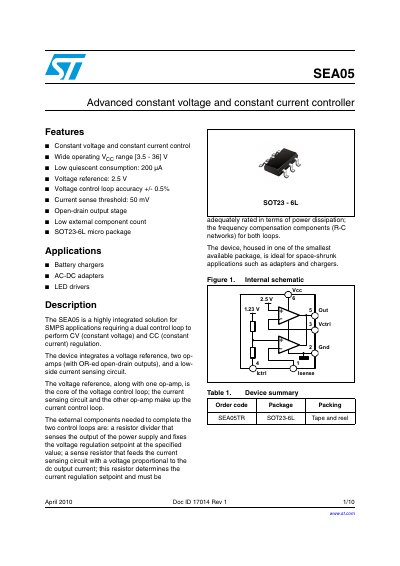
The SEA05 is a highly integrated solution designed for SMPS applications requiring dual control loops for constant voltage (CV) and constant current (CC) regulation. It integrates a voltage reference, two operational amplamps with OR-ed open-drain outputs, and a low-side current sensing circuit. The device is housed in a compact SOT23-6L micro package, making it ideal for space-constrained applications such as battery chargers and AC-DC adapters.
| Operating voltage range | 3.5 to 36 V |
|---|---|
| Quiescent current | 200 µA |
| Voltage reference | 2.5 V |
| Current sense threshold | 50 mV |
| Package type | SOT23-6L |
| Max sink current | 20 mA |
The device is suitable for battery chargers, AC-DC adapters, and LED drivers.
The quiescent current is typically 200 µA when the output is open and inputs are zero.
The setpoint is determined by a sense resistor that feeds the current sensing circuit with a voltage proportional to the DC output current.