
The TL1593C is a three-channel sample-and-hold integrated circuit designed for use in processing video signals generated by TI virtual-phase CCD image sensors. It can be used with one-, two-, and three-channel color and monochrome TI virtual-phase CCDs. Each sample-and-hold channel consists of a differential-input buffer, a digitally controlled switch, and an output buffer that has high impedance. Separate supply and ground pins are provided for the analog and digital sections to ensure optimum isolation. Internal-hold capacitors are included to reduce the external parts count. The differential inputs allow the amplifier return pin of the imager to be connected to CIN of the sample-and-hold circuit to obtain common-mode rejection for antiblooming clock transients in the CCD. The analog inputs should be capacitively coupled from the CCD outputs to ensure optimum performance. The TL1593C is supplied in a 16-pin plastic package and is characterized for operation from 0°C to 70°C.
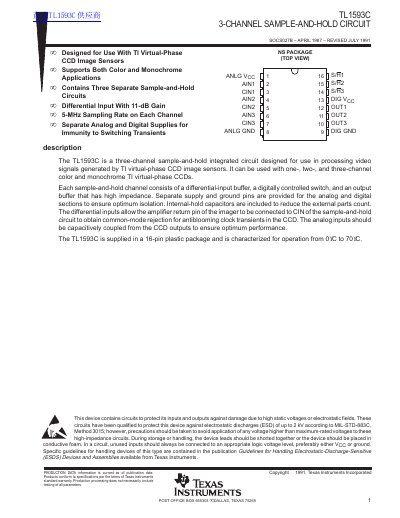
The TL1593C is a three-channel sample-and-hold integrated circuit designed for use in processing video signals generated by TI virtual-phase CCD image sensors. It supports both color and monochrome sensors and features separate analog and digital supplies for optimum isolation. Each channel includes a differential-input buffer, a digitally controlled switch, and an output buffer with high impedance. Internal hold capacitors are included to reduce external parts count.
The device is supplied in a 16-pin plastic package and is characterized for operation from 0°C to 70°C. It includes circuits to protect inputs and outputs against damage due to high static voltages or electrostatic fields, qualified to protect against ESD of up to 2 kV according to MIL-STD-883C.
| Sampling frequency | 5 MHz |
|---|---|
| Sampling time | 55 ns |
| Operating free-air temperature | 0°C to 70°C |
| Output sink current | 0.4 mA |
It is designed for use in processing video signals generated by TI virtual-phase CCD image sensors.
Yes, it can be used with one-, two-, and three-channel color and monochrome TI virtual-phase CCDs.
The device is qualified to protect against electrostatic discharges (ESD) of up to 2 kV.