
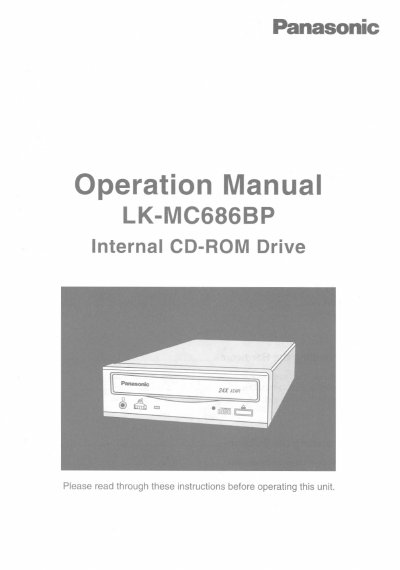
The Panasonic LK-MC686BP is an internal CD-ROM drive featuring 24X speed technology. This operation manual guides users through the installation process, including hardware setup in vertical or horizontal orientations and software driver installation for DOS and Windows environments.
The document covers system requirements, handling guidelines for CD media, and detailed steps for installing device drivers and utilities such as 'CD Listener'. It also includes a troubleshooting section for common drive issues and provides specific performance specifications regarding error rates and audio capabilities.
| Speed | 24X |
|---|---|
| Laser Type | Semiconductor laser GaAlAs |
| Wavelength | 790+ 25 nm |
| Output Power | 0.22 mW |
The drive requires an IBM PC-AT or compatible computer with a processor of 80286, 80386, 80486, or Pentium, running PC-DOS Ver 6.3+, MS-DOS Ver 6.0+, or Windows 3.1/NT/95.
This unit uses CD-ROM discs that bear the 'COMPACT DISC DIGITAL AUDIO' mark; only digital audio compact discs having this mark can be used.
No, users should not attempt to disassemble the cabinet or remove covers. Servicing must be performed by qualified personnel only.