
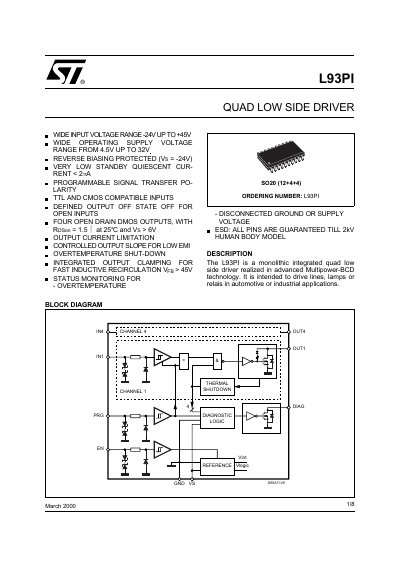
The L93PI is a monolithic integrated quad low side driver made in Multipower-BCD technology. The datasheet states it is intended to drive lines, lamps or relays in automotive or industrial applications, and lists four open drain DMOS outputs, TTL/CMOS-compatible inputs, programmable signal transfer polarity, output current limitation, controlled output slope and overtemperature shutdown.
The document provides the block diagram, pin connection and pin description, absolute maximum ratings, thermal data, operating conditions and electrical characteristics. It also includes a circuit description, diagnostic table, an application circuit for inverting transfer polarity, and SO20 outline and mechanical data.
| Input voltage range | -24 V to +45 V |
|---|---|
| Outputs | Four open drain DMOS outputs |
| ESD protection | All pins guaranteed to 2 kV human body model |
| Short-circuit current | 400 mA min, 700 mA typ, 1200 mA max |
| Overtemperature switch-off level | 160 °C to 190 °C |
| Output clamp voltage | Typ. 50 V during inductive flyback |
| Junction temperature range | -40 °C to 150 °C |
It is a monolithic integrated quad low side driver in Multipower-BCD technology, intended to drive lines, lamps or relays in automotive or industrial applications.
It has four open drain DMOS outputs.
A high signal on PRG changes the signal transfer polarity from noninverting to inverting mode.
A separate thermal shutdown deactivates the output that exceeds the switch-off level; it is activated again about 20 K below the threshold.