
This is an application note that introduces LIN bus, features of LIN bus and ST's LIN silicon products.
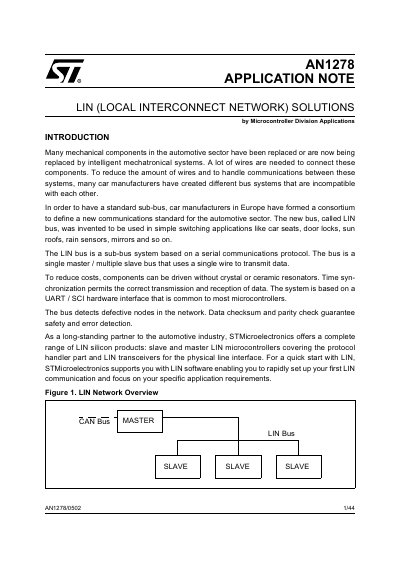
The document introduces the Local Interconnect Network (LIN) bus as a standard sub-bus system for automotive applications. It explains that the LIN concept uses a single master/multiple slave model with a serial communications protocol based on a UART/SCI hardware interface.
The note details STMicroelectronics' product range, including various LIN microcontrollers suitable for master and slave nodes, as well as L9637 and L9638 transceivers. It also covers the provided LIN software package, detailing types, macros, protocol handlers, and configuration files.
| Operating Supply Voltage (Slave MCUs) | 3.2V to 5.5V |
|---|---|
| CPU Frequency (Slave MCUs) | Up to 8MHz |
| Operating Temperature Range | -40°C to +85°C |
The LIN concept uses a single master/multiple slave model where only the master can initiate communication.
Time synchronization allows slaves to measure the master bit time using a sync field byte consisting of 0x55.
The package consists of the protocol specification, the configuration language description, and the software implementation API.