
an1501 is an application note that introduces how microcontroller can be used in electronic ballast, and provides a brief introduction of the basic working principle of microcontroller and the advantages and disadvantages of implementing microcontroller in electronic ballast.
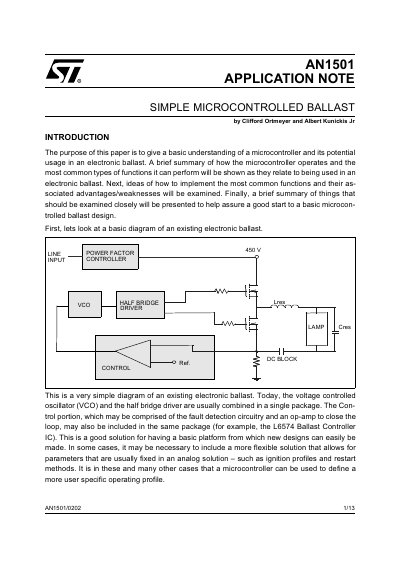
The document provides a basic understanding of using microcontrollers in electronic ballast designs. It contrasts traditional voltage-controlled oscillator (VCO) solutions with flexible microcontroller-based approaches that allow for user-specific operating profiles.
Key topics include microcontroller fundamentals such as configuring input/output pins, analog inputs for dimming control, and push-pull or open-drain outputs. The text also details the use of autoreload timers to manage PWM frequency and duty cycle independently.
To define a more user-specific operating profile and allow for flexible parameters like ignition profiles and restart methods.
It acts as an A/D converter, transforming voltage levels between 0V and 5V into numbers between 0 and 255 for control logic.
The reload register sets the frequency, while the compare value determines the duty cycle by switching the output low at that specific count.