
This application note describes the demonstration board of the all primary-sensing switching regulator ALTAIR05T-800 and presents the results of its bench evaluation. The board implements a 5 W (5 V / 1 A) wide range mains battery charger with constant voltage/constant current. The ALTAIR05T-800 combines a high-performance low-voltage PWM controller chip and an 800 V, avalanche rugged power MOSFET in the same package. The PWM chip is a quasi-resonant (QR) current mode controller IC specifically designed for QR ZVS (zero-voltage switching at switch turn-on) flyback converters. The device is capable of providing constant output voltage (CV) and constant output current (CC) regulation using primary sensing feedback. This eliminates the need for the optocoupler, the secondary voltage reference, as well as the current sensor, while maintaining very accurate regulation. Additionally, it is possible to compensate the voltage drop of the output cable, so as to improve CV regulation on the externally accessible terminals. Extremely low consumption under no-load conditions is ensured thanks to a controlled burst mode operation that, along with the built-in high-voltage startup circuit and the low operating current of the device, helps minimize residual input consumption. Although an auxiliary winding is required in the transformer to correct
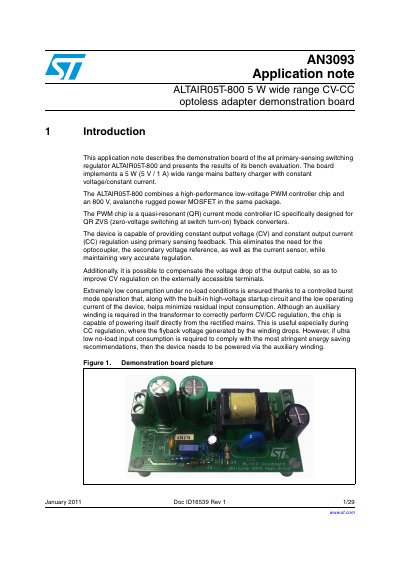
This document presents a demonstration board for the ALTAIR05T-800, an all-primary-sensing switching regulator designed for 5 W wide range mains battery chargers. The board implements constant voltage (CV) and constant current (CC) regulation without the need for an optocoupler, secondary voltage reference, or current sensor. The ALTAIR05T-800 combines a quasi-resonant PWM controller chip with an 800 V avalanche rugged power MOSFET in a single package.
| Input voltage range | 90 - 265 Vac |
|---|---|
| Mains frequency | 50 - 60 Hz |
| Maximum rated output power | 5 W (5 V/1 A) |
| Minimum switching frequency | 70 kHz |
| Target average efficiency | > 70% |
It uses primary sensing feedback which eliminates the need for an optocoupler, secondary voltage reference, and current sensor.
Yes, the device is capable of compensating for the voltage drop of the output cable to improve CV regulation.
It operates in a controlled burst mode to ensure extremely low consumption.