
This application note details the main features and application advantages of STMicroelectronics’ new synchronous step-down regulator. After describing how the device works and the main features, a step-by-step design section is provided in order to help with the selection of the external components and the evaluation of the losses. The device performances are shown in terms of efficiency and thermal results. In conclusion, some application ideas are proposed.
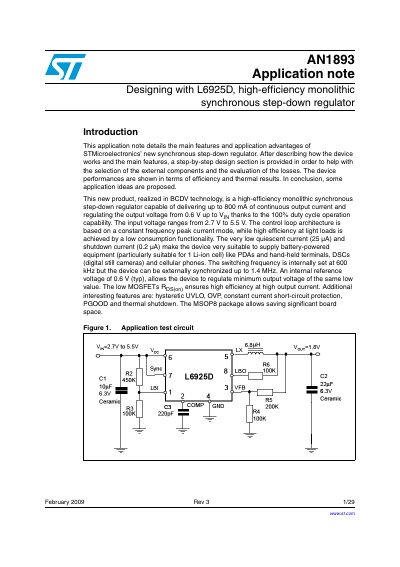
This document provides a comprehensive guide to the L6925D, a high-efficiency monolithic synchronous step-down regulator capable of delivering up to 800 mA of continuous output current. It covers the device's main features, including its constant frequency peak current mode architecture, low consumption functionality with 25 µA quiescent current, and various protection mechanisms like thermal shutdown and short-circuit protection. The regulator is designed for battery-powered equipment, supporting input voltages from 2.7 V to 5.5 V and output voltages from 0.6 V up to the input voltage.
| Continuous output current | 800 mA |
|---|---|
| Output voltage range | 0.6 V up to Vix |
| Input voltage range | 2.7 V to 5.5 V |
| Switching frequency | 600 kHz (internally set) |
| Maximum synchronization frequency | 1.4 MHz |
| Internal reference voltage | 0.6 V (typ) |
| Package type | MSOP8 |
Yes, the device can be externally synchronized up to 1.4 MHz.
The device can regulate a minimum output voltage of 0.6 V thanks to its internal reference voltage.
Yes, it includes constant current short-circuit protection along with other features like OVP and thermal shutdown.