
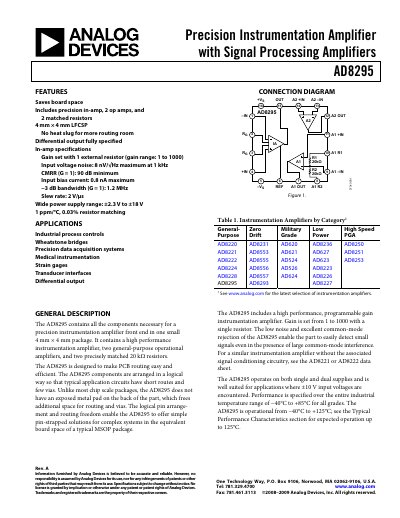
The AD8295 is a precision instrumentation amplifier designed to save board space by integrating a high-performance instrumentation amplifier, two general-purpose operational amplifiers, and two precisely matched 20 kΩ resistors into a single 4 mm × 4 mm LFCSP package. It is designed to make PCB routing easy and efficient, offering simple pin-strapped solutions for complex systems in the equivalent board space of a typical MSOP package. Unlike most chip scale packages, the AD8295 does not have an exposed metal pad on the back, freeing additional space for routing and vias.
| Package Type | 4 mm × 4 mm LFCSP |
|---|---|
| Gain Range | 1 to 1000 |
| Input Voltage Noise | 8 nV/√Hz maximum at 1 kHz |
| CMRR (G = 1) | 90 dB minimum |
| Input Bias Current | 0.8 nA maximum |
| −3 dB Bandwidth (G = 1) | 1.2 MHz |
| Slew Rate | 2 V/μs |
| Power Supply Range | ±2.3 V to ±18 V |
| Resistor Matching | 0.03% |
| Operating Temperature Range | −40°C to +85°C |
The gain can be set from 1 to 1000 with a single external resistor.
No, the AD8295 does not have an exposed metal pad on the back of the part.
The device includes two precisely matched 20 kΩ resistors.