
Analog Devices AN-393 Considerations for Selecting DSP Processor ADSP-2115 vs TMS320C5x

This document introduces the selection method of DSP processor, including speed, flexibility and dynamic range
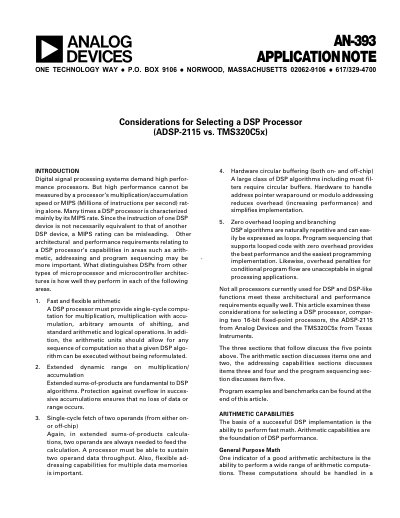

Analog Devices AN-393 Considerations for Selecting DSP Processor ADSP-2115 vs TMS320C5x - cover page
Brand
Analog Devices
Category
Other Electronics
Document type
Application Note
Language
English
Pages
16
File format
PDF
File size
151 KB
Published
03 August, 2012
Updated
30 September, 2023
MD5 checksum
F29745F42EA77B07775800B2B6FD4D68

About this manual

This document serves as a technical comparison between two 16-bit fixed-point digital signal processors: the ADSP-2115 from Analog Devices and the TMS320C5x from Texas Instruments. It argues that performance cannot be measured solely by MIPS ratings or multiplication/accumulation speed, but must consider specific architectural requirements.

What's inside

  • Introduction
  • Arithmetic Capabilities
  • General Purpose Math
  • ADSP-2115 Arithmetic Architecture
  • TMS320C5x Arithmetic Architecture
  • Extended Dynamic Range
  • Single-cycle Fetch of Two Operands
  • Hardware Circular Buffering
  • Zero Overhead Looping and Branching

Specifications

Processor Type16-bit fixed-point
Clock Speed20 MHz
Cycle Time50 ns
Computational UnitsALU, MAC, Barrel Shifter

Frequently asked questions

Why is MIPS rating potentially misleading for DSP selection?

A MIPS rating can be misleading because the instruction of one DSP device is not necessarily equivalent to that of another DSP device.

What distinguishes DSPs from other microprocessor architectures?

DSPs are distinguished by their performance in arithmetic, addressing, and program sequencing capabilities.

Does the ADSP-2115 require algorithm reformulation for arithmetic operations?

No, the ADSP-2115 allows for any sequence of computation so that a given DSP algorithm can be executed without being reformulated.

Download PDF (151 KB)

More Analog Devices Manuals


View all Analog Devices manuals →