
This document is a guide on using Analog Devices' DSP, audio, and video components. It covers language extensions, memory storage types, ASM, and inline constructs. The document provides examples and guidelines to help users better understand and program ADSP processors.
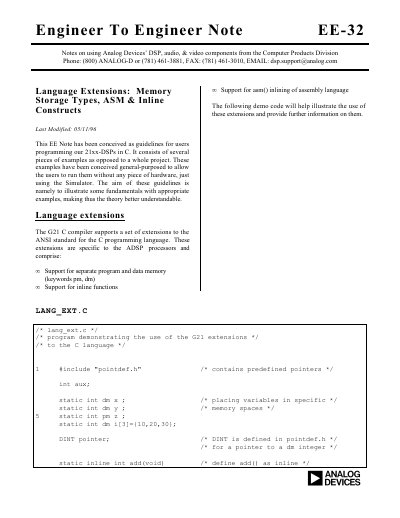
This document serves as a guide for users programming Analog Devices 21xx-DSPs using the G21 C compiler. It focuses on specific language extensions that deviate from the ANSI C standard to optimize performance and utilize the processor's architecture. The note provides guidelines and code examples rather than a complete project.
| Processor Family | 21xx-DSPs |
|---|---|
| Compiler Version | G21 |
| Architecture Type | Modified Harvard |
The compiler supports separate program and data memory spaces using the keywords pm and dm.
The asm() construct allows coding assembly language instructions directly within a C function.
It prevents the asm() instruction from being deleted or moved significantly by the compiler.