
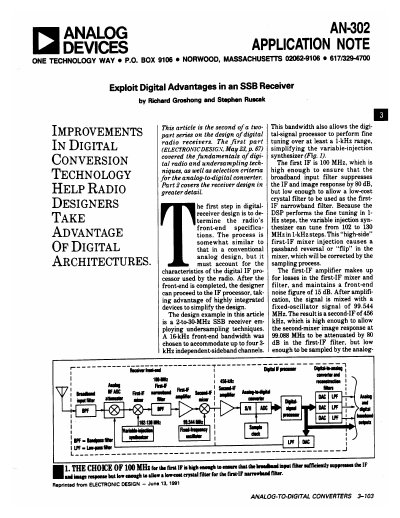
This document is the second part of a two-part series on designing digital radio receivers, focusing on exploiting digital advantages in Single Sideband (SSB) receiver design. It covers the selection of analog-to-digital converters (ADCs) and the implementation of undersampling techniques to simplify receiver architecture. The text provides a specific design example of a 2-to-80-MHz SSB receiver.
| Receiver Bandwidth | 2-to-80-MHz |
|---|---|
| Front-End Bandwidth | 16-kHz |
| First IF Frequency | 100 MHz |
| Second IF Frequency | 456 kHz |
| Front-End Noise Figure | 15 dB |
| ADC Resolution | 14 bits |
| ADC Sample Frequency | 96 kHz |
The first IF is set to 100 MHz to ensure the broadband input filter suppresses the IF and image response by 80 dB while allowing a low-cost crystal filter.
Undersampling frequency translates the second IF to a lower frequency of one-fourth the sample frequency, creating a passband reversal that counteracts the first IF mixer reversal.