
This application note describes a technique to evaluate DUT noise by removing external noise sources. A residual phase noise setup is used to isolate and measure the additive phase noise contribution of a device. Designers use this information to select individual devices for their signal chain, which, in aggregate, meet the phase noise requirements for their complete system. The benefit of a residual phase noise setup is that the effect of noise sources external to the device under test (DUT), such as power supplies or input clocks, can be canceled from the measurement. Conversely, an absolute phase noise measurement includes the impact of power supply noise and reference clock noise. This application note includes actual phase noise measurement plots of a clocked device to highlight the attributes of the residual phase noise setup. In addition, it demonstrates how the additive phase noise of a device can be used to identify the source of noise-related issues in the signal chain.
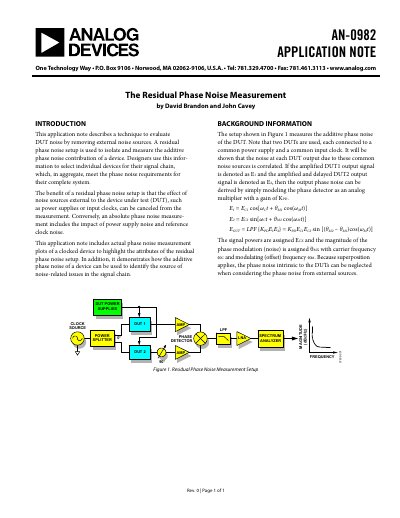
The document details a measurement technique designed to isolate and measure the additive phase noise contribution of a specific device under test (DUT). By utilizing two identical DUTs connected to common power supplies and input clocks, the method cancels out correlated external noise sources such as supply noise and clock jitter. This allows designers to identify individual component contributions within a signal chain.
The effect of noise sources external to the device under test, such as power supplies or input clocks, can be canceled from the measurement.
Since the noise intrinsic to each DUT is uncorrelated and assumed equal, 3 dB is subtracted from the phase noise measured on the spectrum analyzer.