
The AD7869 is a complete 14-bit I/O system containing a DAC and an ADC. The ADC is a successive approximation type with a track-and-hold amplifier, having a combined throughput rate of 83 kHz. The DAC has an output buffer amplifier with a settling time of 4 µs to 14 bits. Temperature compensated 3 V buried Zener references.
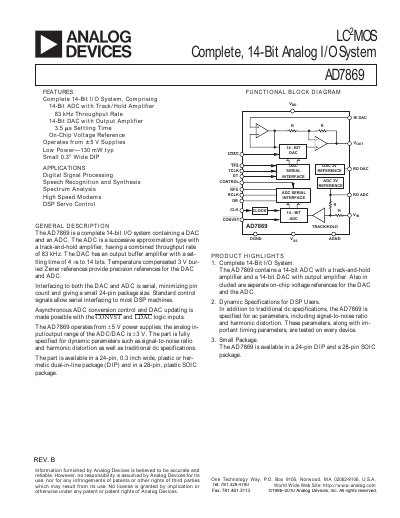
The AD7869 is a complete 14-bit analog input/output system containing a 14-bit successive approximation ADC with a track-and-hold amplifier and a 14-bit DAC with an output buffer amplifier. It features an on-chip 3V temperature-compensated buried Zener reference for both the ADC and DAC, minimizing external component requirements. The device operates from ±5V power supplies with an analog input/output range of ±3V and is available in 24-pin DIP and 28-pin SOIC packages.
| Resolution | 14 Bits |
|---|---|
| Throughput Rate | 83 kHz |
| Settling Time | 4 µs |
| Total Harmonic Distortion (THD) | -86 dB typ |
| Power Supply Voltage | ±5 V |
| Analog Input/Output Range | ±3 V |
| Operating Temperature (J Version) | 0 °C to +70 °C |
| Operating Temperature (A Version) | -40 °C to +85 °C |
The ADC has a combined throughput rate of 83 kHz.
The device operates from ±5 V power supplies.
The analog input/output range is ±3 V.