
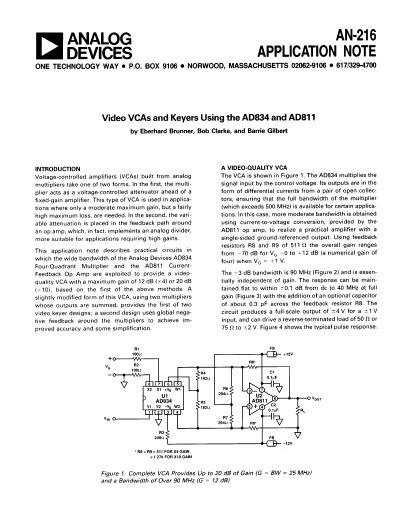
This document describes practical circuits for building video-quality voltage-controlled amplifiers (VCAs) and video keyers using the Analog Devices AD834 Four-Quadrant Multiplier and the AD811 Current-Feedback Op Amp. The VCA circuits provide a maximum gain of 12 dB or 20 dB with a bandwidth exceeding 90 MHz for the lower gain version.
The note also details a two-input video keyer design that blends two video sources under the control of a third signal. This circuit achieves a bandwidth of about 85 MHz and provides signal isolation of approximately -60 dB when one channel is fully off.
| Maximum Gain (12 dB version) | 12 dB (x4) |
|---|---|
| Maximum Gain (20 dB version) | 20 dB (x10) |
| Bandwidth (12 dB version) | 90 MHz |
| Bandwidth (20 dB version) | 25 MHz |
| Multiplier Bandwidth | exceeds 500 MHz |
| Keyer Bandwidth | 85 MHz |
| Keyer Flat Response Frequency | 30 MHz |
The circuits use the Analog Devices AD834 Four-Quadrant Multiplier and the AD811 Current-Feedback Op Amp.
It blends two video inputs (Va and Vb) under the control of a signal (Vg) to create effects like dissolves and overlays.