
CMOS Oscillators INTRODUCTION This note describes several square wave oscillators that can be built using CMOS logic elements. These circuits offer the following advantages: Guaranteed startability Relatively good stability with respect to power supply variations Operation over a wide supply voltage range (3V to 15V) Operation over a wide frequency range from less than 1 Hz to about 15 MHz Low power consumption Easy interface to other logic families and elements in- cluding TTL Several RC oscillators and two crystal controlled oscillators are described. The stability of the RC oscillator will be suffi- cient for the bulk of applications; however, some applications will probably require the stability of a crystal. Some applica- tions that require a lot of stability are: 1. Timekeeping over a long interval. A good deal of stability is required to duplicate the performance of an ordinary wrist watch (about 12 ppm). This is, of course, obtain- able with a crystal. However, if the time interval is short and/or the resolution of the timekeeping device is rela- tively large, an RC oscillator may be adequate. For ex- ample: if a stopwatch is built with a resolution of tenths of seconds and the longest interval of interest is two min- utes, then an accuracy of 1 part in 1200 (2 minutes x 60 seconds/minute x 10 tenth/second) may be acceptable since any error is less than the resolution of the device. 2. When logic elements are operated near their specified limits
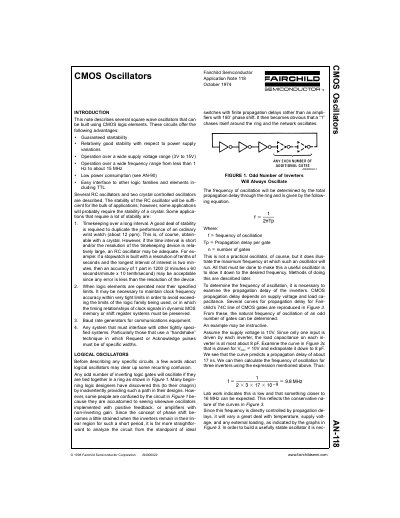
The document details the advantages of building square wave oscillators with CMOS logic, such as guaranteed startability, stability over power supply variations, and operation across a wide voltage range (3V to 15V) and frequency range (less than 1Hz to about 15 MHz). It highlights low power consumption and easy interfacing with other logic families like TTL.
The text provides descriptions for several specific oscillator circuits. These include logical oscillators using an odd number of inverting gates, stable RC oscillators utilizing three inverters, a two-gate oscillator that may not necessarily oscillate without sufficient capacitance, and an oscillator constructed from a single Schmitt trigger.
The circuits operate over a wide supply voltage range from 3V to 15V.
They can operate over a wide frequency range from less than 1 Hz to about 15 MHz.
An accuracy of 1 part in 1200 may be acceptable for such a device.